


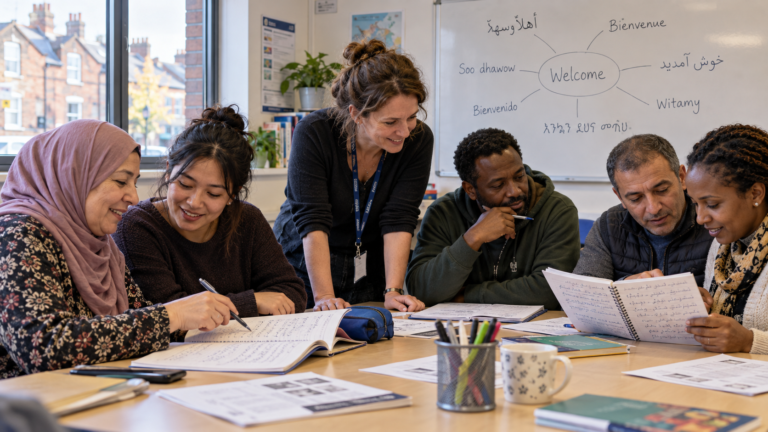

Walk into almost any ESOL classroom in the UK and you will find a room full of multilingual people being taught as if English were the only language in it. Learners move between Arabic, Tigrinya, Dari, Polish and English at the bus stop, at the GP and on the phone to family. Then they come to class and, in many settings, are asked to leave all but one of those languages at the door.
Translanguaging challenges that norm. The term has been around for three decades, but the past eighteen months have brought a noticeable wave of new work on adult migrants specifically: a major review in Language Teaching, fresh classroom studies from Norway, Italy and the United States, and growing practitioner interest in how to make it work in class. This article sets out where the evidence stands and what it might mean for ESOL teachers and providers.
The word has a British origin. ‘Trawsieithu’ was coined in Welsh by Cen Williams in 1994 to describe bilingual classroom practice, and was later carried into English and taken up internationally, most influentially by Ofelia García and Li Wei, whose book, Translanguaging: Language, Bilingualism and Education (Palgrave, 2014) became the standard reference on the subject and won the BAAL (British Association for Applied Linguistics) book prize in 2015.
In practice, translanguaging pedagogy means treating learners’ whole linguistic repertoire as a resource for learning English, rather than as interference. In an ESOL class that might look like:
None of this abandons English as the goal. The argument is that English is learned better, and learners feel more secure, when what they already know is allowed into the room. Some researchers are careful to distinguish this planned, pedagogical use from simply tolerating L1 use; the newer literature often uses the term pedagogical translanguaging for the former.

The most useful starting point is Bronagh Ćatibušić’s critical review of research on language education with adult migrants, 2017–2024, published in Language Teaching in June 2026. Pedagogical translanguaging runs through it as one of the field’s main asset-based approaches, i.e. an approach that builds on what learners already know (rather than what they don’t know) including with adults with limited or interrupted educations. A second review, by Ingeson and Bagga-Gupta in Studies in the Education of Adults, maps the wider scholarship on adult migrant language education.
The classroom studies are small and mostly qualitative, but they are consistent:
Two patterns stand out. Benefits reported are mostly affective and social (confidence, participation, identity) rather than measured gains in English proficiency. And several authors still describe adult migrant translanguaging research as scarce compared with work in schools.
The UK has a strong research heritage here but surprisingly little recent classroom evidence. The most significant work remains the AHRC-funded TLANG project (Translation and Translanguaging), which studied communication in highly diverse neighbourhoods of four UK cities. From it came James Simpson and Melanie Cooke’s 2017 NATECLA keynote and Simpson’s later chapter, Translanguaging in ESOL: Competing Positions and Collaborative Relationships. Their core argument still frames the debate: ESOL learners live multilingual lives, but ESOL policy and practice often remains oriented to a monolingual norm.
At practitioner level, translanguaging is increasingly discussed. A NATECLA Cymru session shared via the Learning and Work Institute in late 2025, for example, put teachers through a short Arabic lesson to experience what pre-entry learners face, then introduced translanguaging as an alternative to ‘English only’.
One new UK study, looking at learners, is Kamran Amin’s interview study of eight adult ESOL learners in an English FE college (August 2026). Learners valued purposeful first-language use for comprehension and participation, made their own judgements about when it helped, and expected to need it less as their English grew. The findings are consistent with the international work referenced above.
A second new study looks at teachers. In NATECLA’s Summer 2026 Language Issues journal, Chathuska Undugoda of City of Oxford College reports a pilot survey of 16 experienced ESOL teachers. All had tried translanguaging and most felt confident about it, but they were selective in practice. Letting stronger learners help others in their own language, and allowing bilingual dictionaries and translation software, were widely endorsed; the author wonders whether AI translation tools are shifting attitudes. Comparing languages drew a mixed response, and simply letting learners switch to their own languages during activities was the least supported practice.
The barriers teachers named were mostly outside their control: learners’ own preference for ‘English only’ (38%), institutional policy (25%) and lack of training (19%). Only 6% cited their own beliefs. Many responses also showed misunderstandings: that translanguaging means learners using their own language all the time, that it leaves out learners who share no language with classmates, and that it does not suit multilingual classes. Teachers who had met the idea through formal study felt more knowledgeable and reported better classroom experiences than those who had picked it up informally; only 11% had encountered it through CPD. With 16 respondents the findings are indicative only, and they record teachers’ attitudes rather than what works for learners.
However, they give a useful picture of where UK practitioners are, and many of the worries they articulate are the ones Graham Seed addresses below.
TERM’s professional development course for ESOL teachers, Teach English to Refugees and Migrants, dedicates a section to translanguaging. It includes an interview with Cambridge University Press and Assessment researcher, Graham Seed. He came to translanguaging as an EFL teacher who questioned whether the ‘English only’ rule was really the most effective approach, and has since investigated it in his work. In the TERM interview, he offers several practical points that fit closely with the published evidence.
Planned spontaneity. Translanguaging can be spontaneous or structured, and Seed suggests teachers can develop a kind of ‘planned spontaneity’: being ready to draw on learners’ languages when the moment calls for it.
Genuine and strategic translanguaging. He distinguishes two kinds. Genuine translanguaging is the natural use of words from learners’ languages to enrich communication, such as the names of foods or festivals. Strategic translanguaging uses other languages deliberately to help learn English, for example through translation, comparing languages or using subtitles. Genuine translanguaging works at every level; strategic use may be more appropriate at lower levels.
Refugee and migrant learners. Seed sees it as particularly useful here. Learners may find themselves in a very alien environment, so having their language accepted and valued can be highly motivating.
Multilingual and monolingual classes. In a multilingual class, learners can explore each other’s languages and cultures, recognise that they share a similar position, and talk about home cultures and languages they may miss. In a class sharing one language, learners can help each other and use their home language to explain English.
Learners’ reactions vary. Some learners are unsure, because they believe the ‘English only’ rule matters – something highlighted in the research conducted with teachers by Undugoda above. Others find translanguaging very freeing.
Teachers don’t need to speak learners’ languages. Knowing them is a bonus, as it helps teachers understand learners’ struggles, but it isn’t necessary. Teachers may worry about what learners are saying, but in the vast majority of cases there is no need. Seed encourages teachers not to be afraid of letting learners use their language, even just to chat, because it helps create a safe space – an essential tenet of trauma-informed pedagogy.
The main challenge is confidence. Teachers often worry that using other languages isn’t ‘right’ or breaks institutional policy. His advice is to be clear about why you are using translanguaging at that particular moment.
The evidence does not yet justify claims that translanguaging necessarily raises attainment. It does however support a more practical conclusion: planned use of learners’ languages is feasible across levels, including with learners with little prior schooling, and learners themselves tend to value it.
For teachers, that suggests a few low-risk approaches:
For providers and the sector, the bigger questions are about policy and evidence:
The Language of Change