

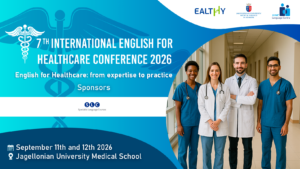
English for Healthcare: from Expertise to Practice — Kraków, September 2026
News · Conference We are delighted to announce that Specialist Language Courses is a sponsor of English for Healthcare: from Expertise to Practice, an international
If you are preparing for the OET and planning to take the computer-based test or OET@Home, the Speaking sub-test will look a little different from what you might imagine. You won’t be sitting in an exam room with an interlocutor across a table — instead, you’ll be at your own desk, connecting remotely via Zoom or the OET Speaking platform. Understanding exactly how this works, and what the examiners are looking for, can make a real difference to your score.
The OET Speaking test is conducted online with a live interlocutor on screen. Before the test begins, you will go through a series of identity and security checks. You may be asked to show your room, your desk, your ears, and the area under your desk. This is entirely standard practice — stay calm, cooperate, and treat it as a routine part of the process.
To sit the test, you will need:
If a technical problem occurs during the test, do not panic. Technical issues are outside your control, and the examiners are aware of this. The OET website provides a detailed user guide covering what to expect, and it is worth reading before your test date.
A common source of confusion for candidates is whether the Speaking test takes place at a test centre or at home. The short answer is: almost always at home, regardless of where you sit your Listening, Reading, and Writing.
If you are taking OET@Home (all parts remotely), your Speaking test will be conducted online on your own computer. If you are taking the OET computer-based test at a test venue, your Listening, Reading, and Writing will be completed there — but your Speaking test will still typically be conducted remotely via OET@Home. Your test centre will confirm the arrangements in advance.
How you open the role play matters more than many candidates realise. The way you initiate the conversation signals your situational awareness — a quality that is assessed throughout the test.
The right opening depends on the scenario:
Reading the role play card carefully will help you identify which type of opening is appropriate. Examiners notice when candidates deliver a generic greeting that doesn’t fit the context, so it is worth taking a moment before you speak.
Examiners can tell when a candidate is not genuinely listening. In a real patient consultation, listening is how you gather information, identify concerns, and build trust — and the same applies in the role play. You need to respond to what the patient actually says, not simply deliver the information on your card regardless of their reaction.
This means picking up on concerns the patient raises, asking for clarification when needed, and adapting your approach as the conversation develops. If a patient expresses hesitation about a proposed treatment, for example, a strong candidate will acknowledge that hesitation before pressing on — not ignore it.
Empathy must be present throughout the role play, not just dropped in as a single phrase. A common mistake is repeating the same expression — “I understand your concerns” — which quickly sounds mechanical and insincere.
Instead, vary your language to reflect the specific situation:
Empathy that responds to what the patient has just said feels human and genuine. That is precisely what examiners are looking for.
You may be presented with a patient who hasn’t been following their treatment plan, has a poor diet, or drinks more than the recommended limits. Your role is not to lecture or judge — it is to understand and support.
Acknowledge the difficulty first: “I know that can be hard to keep up with.” Then move into shared decision-making: “Let’s think about what might work best for you.” Suggesting something manageable — rather than prescribing an ideal that feels out of reach — is far more effective both clinically and in the context of the role play.
Effective communication isn’t one-directional. Throughout the role play, you should be checking in with the patient to confirm they have understood and to invite questions. Doing this after sharing information — rather than delivering everything in one long block — also helps avoid overwhelming them.
Simple check-ins work well:
These short phrases keep the conversation collaborative rather than transactional, and they give the role-play patient an opportunity to raise concerns you can then respond to.
Performing well in a Zoom-based role play requires a slightly different kind of preparation from an in-person test. Confidence with the format matters, so practise in the same environment you will use on the day.
The OET Speaking test at home is a controlled, well-structured assessment. Many candidates lose marks not because of their English level, but because of communication habits that can be learned and corrected. To give yourself the best chance:
Specialist Language Courses (SLC) are dedicated to helping healthcare professionals excel in the OET. Our expert-led courses focus on the specific language skills and test strategies needed to succeed. With personalised coaching, practice tests, and targeted exercises, we ensure you build the confidence and competence required for each OET sub-test. Join SLC to boost your chances of achieving the scores you need and advancing your healthcare career

News · Conference We are delighted to announce that Specialist Language Courses is a sponsor of English for Healthcare: from Expertise to Practice, an international

News · Institutional We are delighted to announce that Specialist Language Courses has launched a new institutional licence, giving university and college students access to

Back to Menu ↩ In the OET Speaking sub-test, you perform two role plays in which you are assessed on your ability to ask questions,
Get updates and get the latest materials on Medical English, OET and IELTS
15% OFF all 1-month & 3-month course subscriptions!
