




A major new survey into the employment situation of refugees and migrants in Devon has shed light on the significant barriers preventing highly qualified people from finding work that matches their skills and experience.
Carried out by Dr. Omid Afghan — himself a refugee and former professor at Kabul Education University — the research gathered responses from 325 migrants and refugees living in Devon between November 2024 and May 2025. Alongside the survey questionnaire, Dr. Afghan also conducted semi-structured interviews and focus group discussions with over 150 individuals, giving the research both statistical weight and rich personal insight.
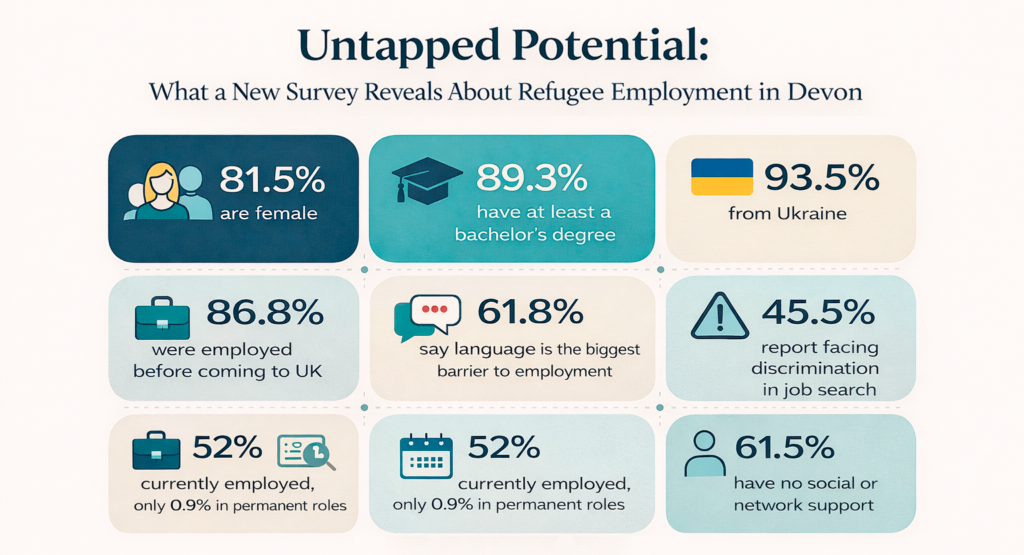
The survey population was predominantly female (81.5%), reflecting the fact that the majority of Ukrainians in Devon under the Homes for Ukraine scheme are women. Ukrainian nationals made up 93.5% of respondents, with smaller numbers from Afghanistan, Hong Kong, and elsewhere. The largest age group was 40–49, followed closely by those aged 30–39, meaning the vast majority of participants were in their prime working years. Over 97% had been in the UK for fewer than three years, placing most at an early and critical stage of resettlement.
The findings challenge common misconceptions about displaced populations: a striking 89.3% of respondents held at least a bachelor’s degree, with nearly half holding a master’s and 8% a doctorate. Almost nine in ten had been in employment before arriving in the UK, in roles ranging from medical doctor and accountant to engineer, lawyer, and university lecturer.
Yet despite this wealth of experience, only 52% were currently employed in the UK — and of those, the vast majority were in part-time, temporary, or zero-hours roles. Just 0.9% held a permanent contract. Many described being repeatedly directed towards low-skilled work entirely unrelated to their professional backgrounds.
Language emerged as the single biggest barrier to employment, cited by 61.8% of respondents. An overwhelming 91.4% expressed interest in work-focused English classes, and the report makes a strong case for expanding access to tailored vocational ESOL courses across sectors such as healthcare, construction, and hospitality. Over two-thirds of respondents had received no career development support whatsoever.
Discrimination was also a significant theme, with 45.5% of participants reporting they had experienced it during the job search process. Many described being stereotyped, overlooked despite strong CVs, or assigned tasks well below their qualification level.
Social isolation compounded these challenges: 61.5% of respondents reported having no social or network support in Devon, a factor that directly affects both wellbeing and job-seeking ability. Mental health pressures were also pronounced, with nearly a third saying their emotional state significantly impacted their ability to look for work.
The report makes clear that the barriers migrants face are structural rather than personal — rooted in non-recognition of overseas qualifications, lack of professional references, limited transport in rural areas, and insufficient coordination between support services.
Its recommendations call for fast-track qualification recognition, expanded ESOL provision, stronger employer engagement, and trauma-informed employment support — all underpinned by a recognition that Devon’s migrant population represents an extraordinary and largely untapped reservoir of talent.
The Language of Change
15% OFF all 1-month & 3-month course subscriptions!