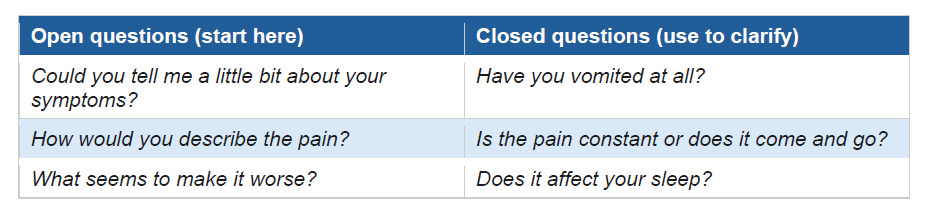
The same principle applies when exploring lifestyle. Rather than launching straight into advice, ask first:
“Could you tell me a bit about your diet?”
“How much exercise do you usually do?”
This allows you to tailor any advice to the patient’s actual situation rather than delivering generic information.
3.3 Confirming and Clarifying Information
When a patient uses vague language, or when you need more detail about something they have said, clarifying questions show that you are listening carefully and that you want to understand accurately.
“What do you mean by feeling funny?”
“You said you felt off balance — do you mean dizzy?”
“You mentioned you often vomit after exercise. How often would that be, exactly?”
You can also use questions to summarise and check your understanding, or to invite the patient to add anything you may have missed:
“So you were cleaning the house, and then what happened?”
“You said it is worse after exercise but not bad at rest — is that right?”
3.4 Finding Out What the Patient Already Knows
Before you explain a condition or treatment, check what the patient already understands. This avoids repeating information they already have and helps you correct any misconceptions. It is also assessed under the information-giving criteria.
“Could you tell me what you know about asthma?”
“How much do you know about this condition at the moment?”
3.5 Checking Understanding (Chunking and Checking)
When providing information, it is not enough simply to deliver it — you need to pause at intervals, check whether the patient has understood, and give them an opportunity to respond. This technique is known as chunking and checking: you deliver a chunk of information and then check in with a question before moving on.
Useful checking questions include:
“Does that make sense so far?”
“Is that clear?”
“Do you have any questions about what I have just explained?”
To encourage the patient to say how they feel about the information:
“How do you feel about that?”
“How does that sound to you?”
3.6 Structuring the Role Play
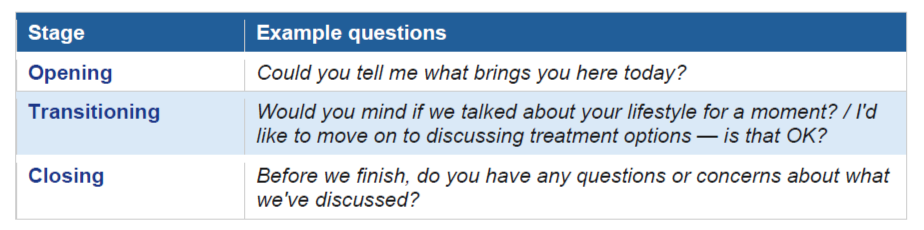
Questions are also one of the most effective tools for managing the flow and structure of the conversation. You can use them to open the role play, to transition between topics, and to obtain consent before asking a series of questions.
Opening the role play:
“Could you tell me what brings you here today?”
Transitioning between topics:
“Would you mind if we talked about your lifestyle for a moment?”
“I’d like to explore the treatment options with you now — is that all right?”
Obtaining consent before a series of questions:
“I’d like to ask you some questions about the pain, if that’s OK.”
“Would you mind if I asked you a few questions about your lifestyle?”
These last two examples are particularly important: they demonstrate a respectful attitude toward the patient which is also part of the clinical communication criteria you are assessed on.