

Specialist Language Courses

AI medical interpreters: the evidence isn’t keeping up

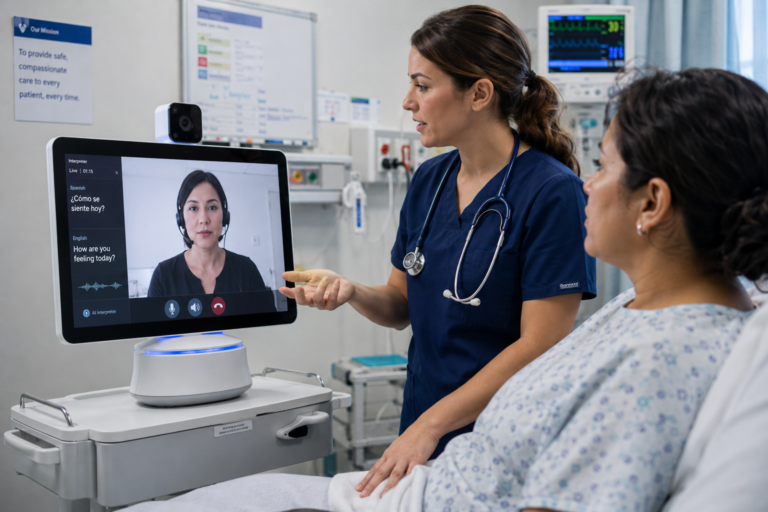
Telemedicine in modern healthcare setting

Artificial intelligence is being adopted across healthcare at a remarkable pace, and language access services are no exception. Hospitals are increasingly trialling AI-powered interpretation tools to help patients who do not speak English as a first language. But according to a research agenda published in npj Digital Medicine in May 2026 by a team from Mass General Brigham and Harvard Medical School, the evidence base for these tools is dangerously thin.

The authors set out to measure exactly how thin. Using several AI research assistants to search the literature, they found that healthcare-related AI publications had grown from roughly 11,500 a year in 2019 to more than 28,000 by 2024. Yet when they narrowed the search to studies that specifically examined AI interpreter services and included the patient’s perspective, the results nearly vanished: fewer than 0.4% of AI-in-healthcare publications even mentioned patient perspectives, and none combined that with a focus on interpreter services specifically.

This gap matters because interpreter access is not optional in many healthcare systems; it is a legal requirement, and extensive prior research shows that professional human interpreters measurably improve communication accuracy, reduce clinical errors, and in some cases shorten hospital stays. The authors warn that swapping trained interpreters for unvalidated AI tools, particularly to cut costs, risks reintroducing exactly the kinds of errors interpreter services were designed to prevent. They cite one recent study which found that around 5% of AI-translated discharge instructions contained at least one error serious enough to potentially delay or endanger a patient’s care.

Rather than rejecting AI interpretation outright, the authors propose a structured research agenda to guide its responsible use: rigorous head-to-head comparisons against human interpreters, studies of how patients actually perceive and trust these tools, usability testing within real clinical workflows, systems for flagging and correcting errors in real time, and governance structures, including advisory boards involving patients and professional interpreters, to oversee high-risk deployments.

Their conclusion is pointed: AI may eventually expand language access in valuable ways, particularly for less common languages where human interpreters are scarce, but only if research and oversight keep pace with deployment rather than trailing behind it.

Did you find this content valuable?

Subscribe to the Medical English Newsletter to receive monthly updates, insights, and resources on Medical English.

More To Explore