



Knowledge Bank
Practising difficult conversations with an AI patient
Back to Menu ↩ Good doctors do not simply tell patients what to do. They explain the options, listen to the patient’s values and concerns,

In medical English classes, we often discuss language barriers in one direction. Whether it be moving overseas for work, attending conferences, or working in international teams, the challenge facing our learners is English, and English is also the solution.
This new open-access study turns that picture around. It looks at language barriers inside a region in India, where many languages are spoken and no single one is shared. Here, English is not the answer. Sometimes it is, in fact, part of the difficulty.
India is the fourth most linguistically diverse country in the world. It has 22 officially recognised languages and hundreds more. Hindi and English are the national official languages, but only about 44% of people speak Hindi and about 11% speak English. In the south, there is no shared language at all. The study took place in Karnataka, where the official language is Kannada — but around 150 languages are spoken in the state.
With a diverse staff working with a diverse patient body and so many languages in play, language must inevitably be a challenge. However, the authors make the point that in the World Health Organization’s most recent report on health equity in India, language was not listed as a concern.
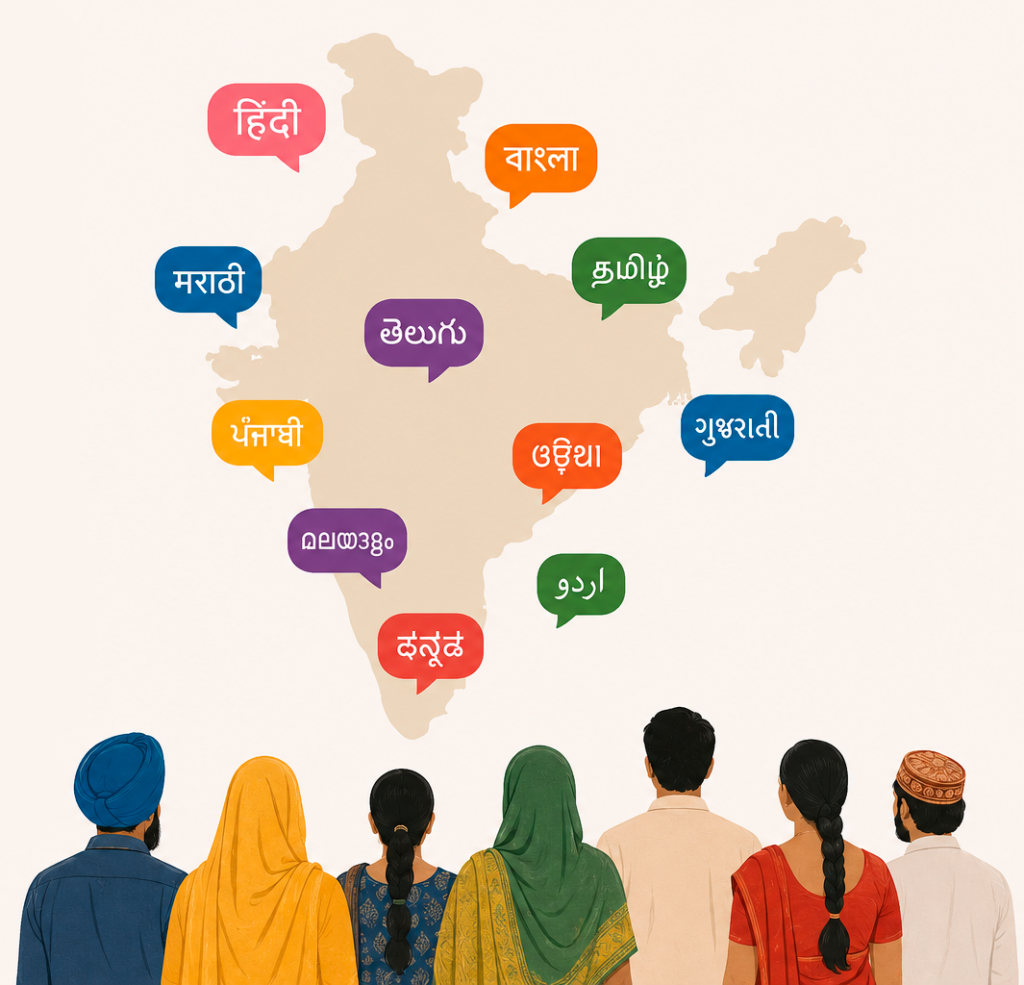
The researchers worked with 50 people in Bengaluru: 25 patients and 25 healthcare workers, speaking 11 languages between them. Data came from one teaching hospital and two urban primary health centres. All 50 completed surveys. Fifteen took part in longer interviews.
The interviews were analysed using thematic analysis, a method for identifying patterns across what people say. The team used two communication theories. The first treats a language barrier as “noise” that damages a message as it travels from speaker to listener. The second looks at how far speakers adjust their language, tone and body language to suit the person in front of them.
The picture is clear. All 25 patients reported problems communicating with healthcare workers, and 24 of 25 healthcare workers said the same. Almost all participants (98%) said no professional interpreter service was available to them. Nearly three-quarters of patients (72%) felt the quality of their care had suffered. And 76% said there was not enough health information available in their own language.
Nearly half the patients (48%) believed they had been misdiagnosed, or had received no diagnosis at all, because of a language problem. Almost a quarter of the healthcare workers (24%) agreed that they had done exactly that. One doctor mistook severe period pain for a stomach complaint until a translator clarified the situation.
Every single participant described an emotional cost. They used words such as mistrust, sadness, frustration, confusion, stress, helplessness and discomfort. Both patients and staff described feeling alone.
The study is careful to link communication problems to poorer patient outcomes.

The clearest area this shows up is in diagnosis. When patients cannot describe their symptoms, doctors are left guessing. One healthcare worker described colleagues treating conditions the patient did not have, while the real problem went untreated. A patient with asthma believed she also had a chest infection, but could not explain this. Her doctor simply told her to continue her existing medication.
The second area is treatment that patients cannot follow. Prescriptions written in an unfamiliar language led to medication being taken at the wrong times. In family planning services, staff described serious consequences when instructions were not understood; injection sites becoming infected, infections spreading through the body, and contraceptive devices failing and leading to unplanned pregnancy. A woman who developed skin infections could not understand the treatment she was offered, so she did not take it and did not heal.
The third area is delay and avoidance. Around 14% of participants avoided care altogether. One patient with worsening neck pain changed doctors four or five times before finding one who shared a language with her; her condition deteriorated while she searched. Others said plainly that if no one at the clinic spoke their language, they would leave without treatment. Some healthcare workers also refused certain patients, fearing they would cause harm.
Cost adds a further layer. One patient believed he was given unnecessary tests, and paid more, whenever he attended without a family member to interpret.
The authors place these findings alongside documented cases elsewhere. In the United States, a teenager became permanently paralysed after a friend’s untrained interpreting contributed to a missed brain haemorrhage. In another case, a young girl died in a situation involving child relatives used as interpreters and no translated documents. The wider evidence, they note, shows the reverse effect too: when patient and clinician share a language, diagnostic accuracy improves, patients follow treatment more closely, and outcomes are better.
The problem isn’t just spoken communication. Around 20% of participants described problems with written materials. Doctors could not read vaccination cards brought from other states. Patients could not read prescriptions. One patient took medication at the wrong times for a period, until an adult child noticed and explained the instructions. One doctor was asked to write a prescription in Kannada, because the village pharmacist did not read English, and could not do it.
In the absence of interpreters, people improvise. Around 68% of healthcare workers and 88% of patients used informal translators — colleagues, other patients, family members, and on one occasion a hospital security guard. Patients often had to bring an adult child to appointments. Participants worried about the burden on relatives, and about mistakes.
About a third relied on gestures. As one patient described it, hand gestures were the only way to communicate. Staff found body language useful for simple exchanges, but agreed it had clear limits.
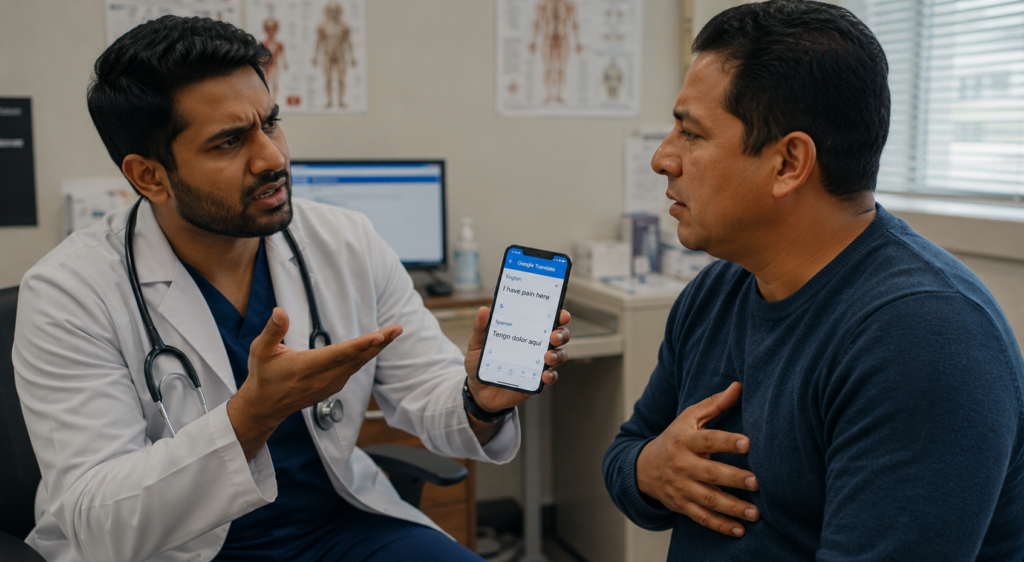
Translation apps were tried and largely abandoned. Around 28% of healthcare workers had used them, and fewer than 1% of patients. Users reported that the output was too literal, too formal, and often meaningless to the patient. Interestingly, many participants still suggested that better AI translation would be the eventual solution.
Some 84% of healthcare workers tried to learn an additional language. One nurse learned enough Kannada in a single month to manage clinical conversations, focusing on key medical words.
But the experience was uneven. One doctor described giving up because mistakes attracted laughter rather than encouragement. Patients described feeling guilt and shame for being monolingual, and for lacking formal education. Several felt their doctor expected them simply to go away and learn the local language.
The study argues that language access needs systemic solutions: professional interpreters, multilingual health materials, inclusive hiring, and translation tools built specifically for medical use in Indian languages.
For language teachers, three things stand out. First, motivation for fast, function-focused clinical language training is clearly there — the nurse who learned working Kannada in a month proves it. Second, shame and blame surround language difficulty, which is a cultural and pastoral issue as much as a pedagogical one. Third, reading and writing matter more in clinical practice than communication courses might assume.
The authors note the limits of their work: one urban area, one state, and findings that may not apply nationally.
Back to Menu ↩ Good doctors do not simply tell patients what to do. They explain the options, listen to the patient’s values and concerns,

Back to Menu ↩ Metaphors can tell us a lot about how people think. A new study, published in Acta Psychologica, uses metaphors to explore

Back to Menu ↩ In many countries, a large part of the healthcare workforce has trained overseas. In the UK for example, international medical graduates