

Specialist Language Courses

Three routes, three timelines

Planning UK settlement routes together

The government’s response to its earned settlement consultation, A Fairer Pathway to Settlement (CP 1707, 2 November 2026), sets out how long different groups must wait before they can apply for indefinite leave to remain (ILR). For refugees, the most important question is no longer just whether someone was granted protection. It’s how they arrived, and what they do after arriving. Three categories matter most for ESOL providers. 

1. UK Resettlement Scheme (UKRS) and other safe and legal routes

UKRS covers refugees brought to the UK through an official programme, usually referred by UNHCR. Refugees admitted through designated safe and legal routes will qualify for settlement after five years. That’s a big change from the November 2025 proposals, which had set a 10-year baseline for resettled refugees. 

The language requirement matters most for our sector. UKRS refugees will need A2 English, and will remain exempt from the Life in the UK test until an appropriate version is available. The A2 concession applies to UKRS only. Other designated routes keep the B2 requirement. These include community sponsorship and the new refugee work and study sponsorship routes. Two further limits apply: 

  • Someone who enters legally on another route and then claims asylum does not qualify for the 5-year path. 
  • The response defines “Legacy Safe and Legal Routes” as UKRS arrivals before 6 April 2027, which suggests later arrivals may be treated differently. 

2. Core Protection

Core Protection is the default status for people who claim asylum in the UK and are granted refugee status, if they didn’t arrive on a safe and legal route. It took effect from 2 March 2026. Refugees are granted an initial 30 months of protection, renewable at review if they still need sanctuary. 

  • Wait for ILR: 20 years. 
  • Illegal entry: anyone who entered the UK illegally will ordinarily face an extra 10 years, but this will not apply where the person is protected by Article 31 of the Refugee Convention. That makes up to 30 years in total. 
  • Requirements at settlement: B2 English and the Life in the UK test. People must also repay any asylum support in full or keep to an agreed repayment plan. 
  • Family reunion: there is no automatic right to bring family members to the UK under Core Protection. 
  • Existing refugees: those not on safe and legal routes who claimed asylum before 2 March 2026 will move to Core Protection, and any time spent with refugee status will count towards settlement. 

3. Core Protection Work and Study (Protection Work and Study)

This route is the way off the 20-year track. Ministers have called it Core Protection Work and Study, but the consultation response calls it Protection Work and Study. It’s for refugees granted protection in the UK who move into sustained work, education or training. 
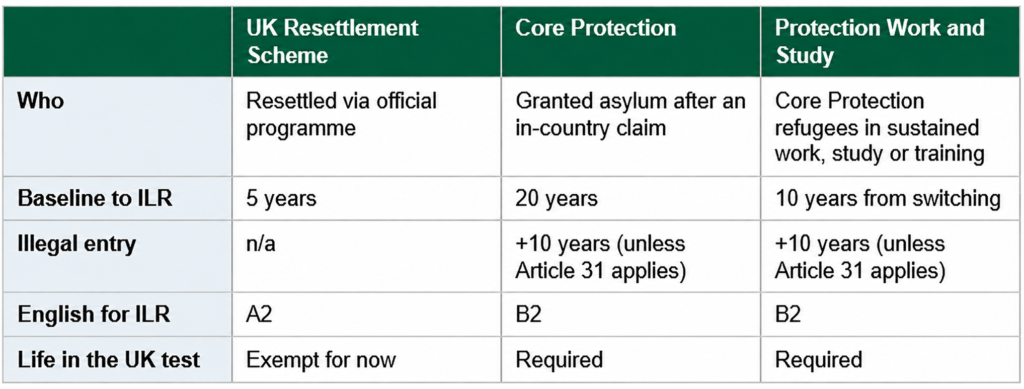
  • Wait for ILR: 10 years, starting when the person moves onto the route. Time already spent on Core Protection doesn’t count. 
  • Work requirement: for people qualifying through work, earning at least £12,571 in three qualifying years. 
  • Other requirements: B2 English, the Life in the UK test, and the same asylum support repayment rules as Core Protection. The extra 10 years for illegal entry can also apply. 
  • Family: people on this route could become eligible to sponsor family members to come to the UK. 

At a glance

Table with a green header row

Other categories in the framework

  • Ukraine schemes and Leave Outside the Rules (LOTR): time on these routes does not count towards the qualifying period. The government will “give further consideration” to LOTR and set out its approach later. 
  • Afghan schemes: outside the framework, with immediate settlement. 
  • Hong Kong BN(O): keeps its 5-year route and sits outside the earned settlement framework. However, the B1 exemption confirmed earlier this year has not survived: BN(O) applicants will need B2 once the new rules take effect (reported as applications from 26 March 2027). Until then, B1 still applies, with over-65s exempt. This is likely to matter to ESOL providers working with Hong Kong communities. 
  • Children and survivors: unaccompanied asylum-seeking children, children in local authority care, and victims of domestic abuse keep current arrangements. 
  • Family and Private Life: 10- or 20-year pathway. Protection and human rights routes cannot be combined with work or family routes. 

What it means for ESOL

The gap between A2 and B2 is the key fact for our sector. Resettled refugees need basic English for settlement. Everyone who came through the asylum system needs upper-intermediate English, and they’re also being pushed into work or study to escape a 20-year wait. With BN(O) holders also moving from B1 to B2, demand for progression from Entry levels to B2, alongside employability, has never mattered more. On timing, a statement of changes to the Immigration Rules is expected in December 2026, with changes taking effect through 2027. 

References