


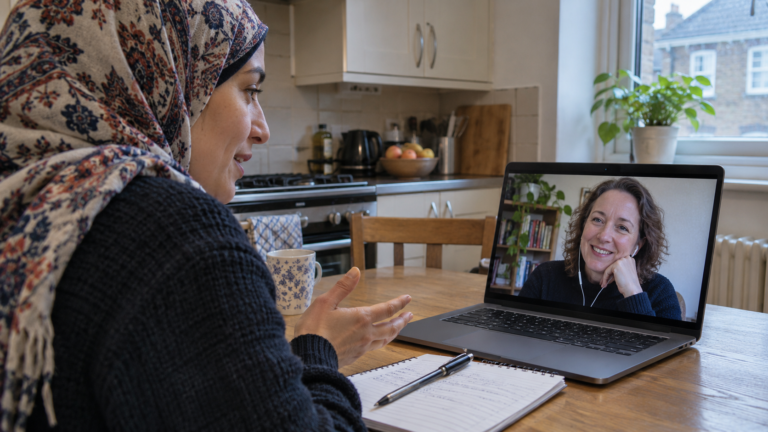

The government is reviewing English language provision with a clear interest in digital delivery, and the debate has quickly split into two camps. One sees online learning as a cheap substitute for teaching. The other sees it as the answer to waiting lists. The evidence supports neither view. Online learning works well for many refugee learners, including some that classrooms have never reached, and it needs the right support for others.
The strongest UK evidence comes from the Home Office’s STEP Ahead pilot, evaluated by Ipsos. The pilot was a 12-week online programme of ESOL and employment support for 411 refugees across the UK. The results are hard to dismiss:
Within 12 weeks, 22% of participants had moved into work, training or volunteering.
The challenges are real, but most of them can be fixed. Most learners joined on a phone even when they had been given a laptop. Often this was because they didn’t know how to use the laptop, and on a phone it is hard to use the chat, download materials or keep a camera on. Learners who were less confident with technology reported less progress, and beginners in particular were less likely to feel the online setting met their needs. Some learners missed what a classroom gives: seeing other learners, keeping each other accountable, and social contact with their local community.
International studies find similar patterns. Research on digital language projects for adult migrants in Germany and the US found that age, gender, education and proficiency shaped who benefited, and that without adapted materials and institutional support, digital tools could reinforce existing inequalities.
None of these problems is a reason to choose the classroom over online learning. They are reasons to design online provision well. That means teaching digital skills at the start, giving technical support throughout, providing devices learners can actually use, keeping class times consistent, and training teachers to use the online tools. For beginners and learners with little literacy, it means extra support and possibly some face-to-face contact.
So, perhaps the real question is not online versus classroom but which learners each suits, and how well each is designed.
The Language of Change