



The government’s response to its earned settlement consultation, A Fairer Pathway to Settlement (CP 1707, 2 November 2026), sets out how long different groups must wait before they can apply for indefinite leave to remain (ILR). For refugees, the most important question is no longer just whether someone was granted protection. It’s how they arrived, and what they do after arriving. Three categories matter most for ESOL providers.
UKRS covers refugees brought to the UK through an official programme, usually referred by UNHCR. Refugees admitted through designated safe and legal routes will qualify for settlement after five years. That’s a big change from the November 2025 proposals, which had set a 10-year baseline for resettled refugees.
The language requirement matters most for our sector. UKRS refugees will need A2 English, and will remain exempt from the Life in the UK test until an appropriate version is available. The A2 concession applies to UKRS only. Other designated routes keep the B2 requirement. These include community sponsorship and the new refugee work and study sponsorship routes. Two further limits apply:
Core Protection is the default status for people who claim asylum in the UK and are granted refugee status, if they didn’t arrive on a safe and legal route. It took effect from 2 March 2026. Refugees are granted an initial 30 months of protection, renewable at review if they still need sanctuary.
This route is the way off the 20-year track. Ministers have called it Core Protection Work and Study, but the consultation response calls it Protection Work and Study. It’s for refugees granted protection in the UK who move into sustained work, education or training.
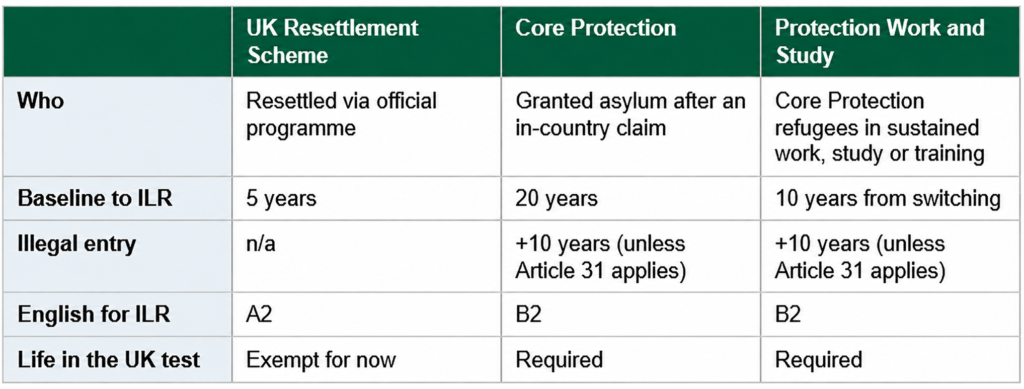
The gap between A2 and B2 is the key fact for our sector. Resettled refugees need basic English for settlement. Everyone who came through the asylum system needs upper-intermediate English, and they’re also being pushed into work or study to escape a 20-year wait. With BN(O) holders also moving from B1 to B2, demand for progression from Entry levels to B2, alongside employability, has never mattered more. On timing, a statement of changes to the Immigration Rules is expected in December 2026, with changes taking effect through 2027.
The Language of Change