




The recent expansion of the right to work for asylum seekers is welcome news, but gaining permission to work is only the first step. For the thousands of highly qualified asylum seekers now eligible to enter the workforce, the ability to function effectively in a professional environment will depend, in large part, on the quality and relevance of the English language support available to them. The implications for ESOL providers are significant.
The Devon County Council survey of 325 refugees and migrants1, published in 2025, makes the scale of the challenge clear. Language was identified as the single biggest barrier to employment by nearly two-thirds of respondents, and an overwhelming 91.4% expressed strong interest in work-focused English classes. The most commonly cited communication challenge was speaking in meetings, followed by writing professional emails and understanding workplace-specific vocabulary. Only 6.2% of respondents felt confident in their current workplace communication skills.
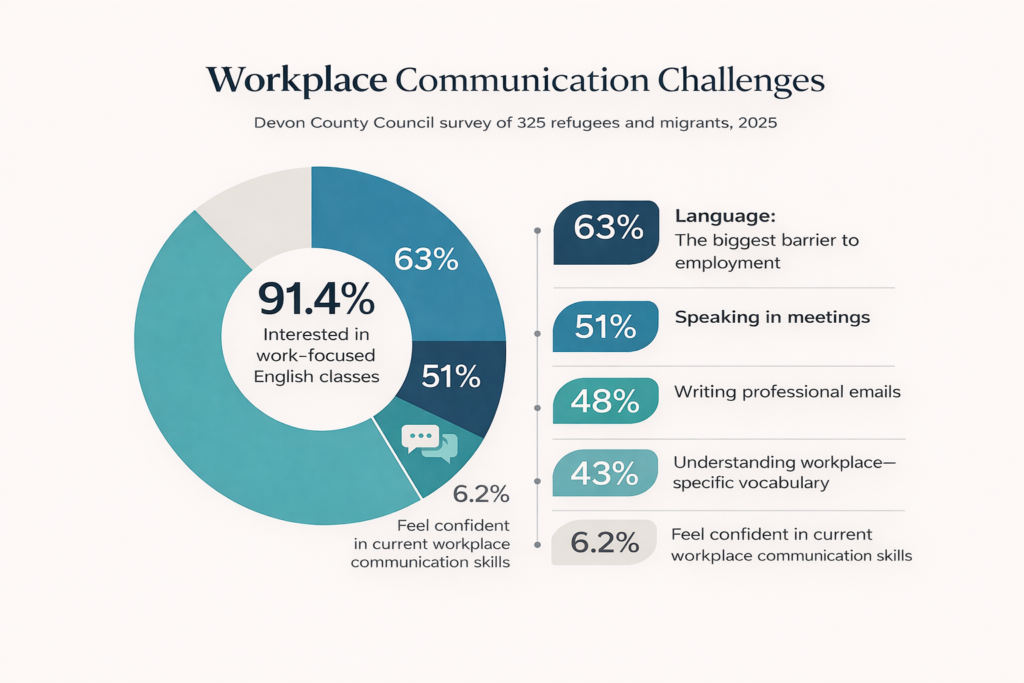
These findings point to a fundamental mismatch: many asylum seekers have the qualifications and professional experience to take up graduate-level roles, but lack the English language proficiency to do so effectively. Now that the right to work has been extended to a much wider range of RQF level 6 roles — across healthcare, engineering, education, law, IT and more — that mismatch is the central challenge that ESOL provision needs to address.
Generic ESOL courses, while essential as a foundation, are unlikely to be sufficient on their own. What is needed is a significant expansion of vocational ESOL provision – courses tailored to the language demands of specific professional contexts.
For asylum seekers with medical backgrounds who may now be eligible to work as doctors, nurses or pharmacists, this means clinical communication, patient-facing English and the professional language of NHS settings, as well as preparation for English tests required for professional registration such as OET or IELTS.
For finance and IT professionals, engineers, lawyers and educators, it means sector-specific vocabulary, formal writing and the interpersonal communication skills needed to operate at graduate level in a UK workplace or take professional exams such as the accountancy ACCA tests. The Devon survey found strong demand for exactly this kind of targeted provision, with participants expressing interest in vocational ESOL courses across a wide range of sectors and professional roles.
ESOL providers and commissioners should be working now to identify where the greatest demand lies locally, and to develop or commission courses that meet it. Given the December 2026 deadline on many of the immigration provisions currently in force, the window of opportunity is real but time-limited.
The exclusion of care workers from the new work rights presents a different kind of challenge. Many asylum seekers and refugees have backgrounds in health and social care — the Devon survey highlighted care work as a common employment background — and those individuals may now need support to identify and prepare for adjacent or alternative roles.
For some, this might mean working towards a nursing auxiliary or healthcare support role at NHS Band 3 level, which remains eligible for sponsorship until at least December 2026. For others, it might mean exploring a longer-term pathway towards a graduate-level health profession. ESOL teachers and employment advisers working with this group have an important role to play in helping learners understand the landscape clearly and make informed decisions about their next steps — and that requires practitioners themselves to be well-informed about the current policy environment.
The Devon research highlighted a strong learner preference for hybrid and flexible delivery — a combination of online and in-person provision — and a clear appetite for structured career development support alongside language learning. Learners were not simply asking for better English; they were asking for English that would help them get and keep the jobs they were qualified for.
This points towards the value of ESOL providers working in closer partnership with local employers, job centres, and sector bodies, so that language courses are designed around real workplace requirements rather than in isolation from them. Employer involvement in curriculum design, work placement opportunities linked to language learning, and mentoring by professionals in relevant fields could all play a role in making provision more effective and more responsive.
For those who commission ESOL provision, these changes make a compelling case for investment in flexible, vocationally focused ESP that can be adapted quickly as immigration policy and labour market conditions continue to evolve.
The approximately 21,000 asylum seekers currently eligible to apply for permission to work represent a significant and largely untapped pool of professional talent. ESOL provision that meets them at the right level, in the right language, and with the right vocational focus could make a decisive difference — both for the individuals concerned and for the communities and employers who stand to benefit from their skills and experience.
The Language of Change
15% OFF all 1-month & 3-month course subscriptions!