




For years, ESOL has been promised a national strategy. Now, for the first time in a generation, there is a genuine window of opportunity. The current government has committed to reviewing English for Speakers of Other Languages (ESOL) provision as part of its Post-16 Education and Skills White Paper — and the sector is watching closely.
The Department for Education (DfE) review focuses on both the content of ESOL programmes and the qualifications learners receive. Its stated aim is to ensure that adults in England who speak English as an additional language can acquire the skills they need for life, work and further study. As part of the process, the DfE has been gathering employer views via an insight survey, with responses requested by 8 May 2026. ¹
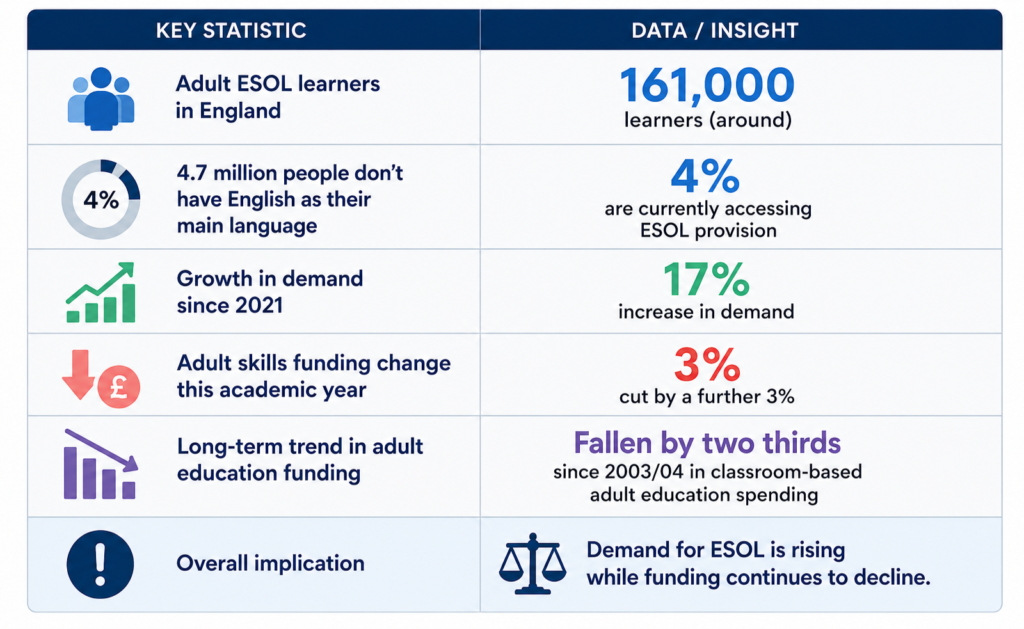
The stakes are high. Government data shows there are around 161,000 adult ESOL learners in England — representing just 4% of all adults in the UK who speak English as a second or additional language. Demand has grown by 17% since 2021, yet adult skills funding has been cut by a further 3% this academic year, continuing a long-term decline that has seen classroom-based adult education spending fall by two thirds since 2003/4. ²
The review also comes at a moment of unusual policy complexity. ESOL now sits at the intersection of three major government agendas: skills and employment, community cohesion, and immigration, with the Immigration White Paper raising the English language bar for skilled workers to B2, a level that most current ESOL provision does not reach. ³ This will also be the level required for Indefinite Leave to Remain from March 2027, a significant jump from the current B1 level.
Writing in FE Week, Diana Sutton of The Bell Foundation welcomed the review but urged caution, warning that ESOL risks being “stretched too thin to deliver on any” of these agendas if not properly resourced. She and others in the sector are calling for the review to result in meaningful qualifications reform, a sustainable funding settlement, and a clear national framework — not just another set of promises. ⁴
The message from providers, teachers and learners is consistent: this is a rare chance. It must not be wasted.
The Language of Change