

Ten years of Germany’s Integration Act: what the evidence says about language and integration
- Sept 2026
- SLC

August marked ten years since Germany’s Integration Act came into force – legislation that tied recognised refugees’ access to the labour market to sustained integration effort, with language learning at its core. A decade on, the evidence offers a useful case study for anyone thinking about how ESOL provision connects to broader integration outcomes.
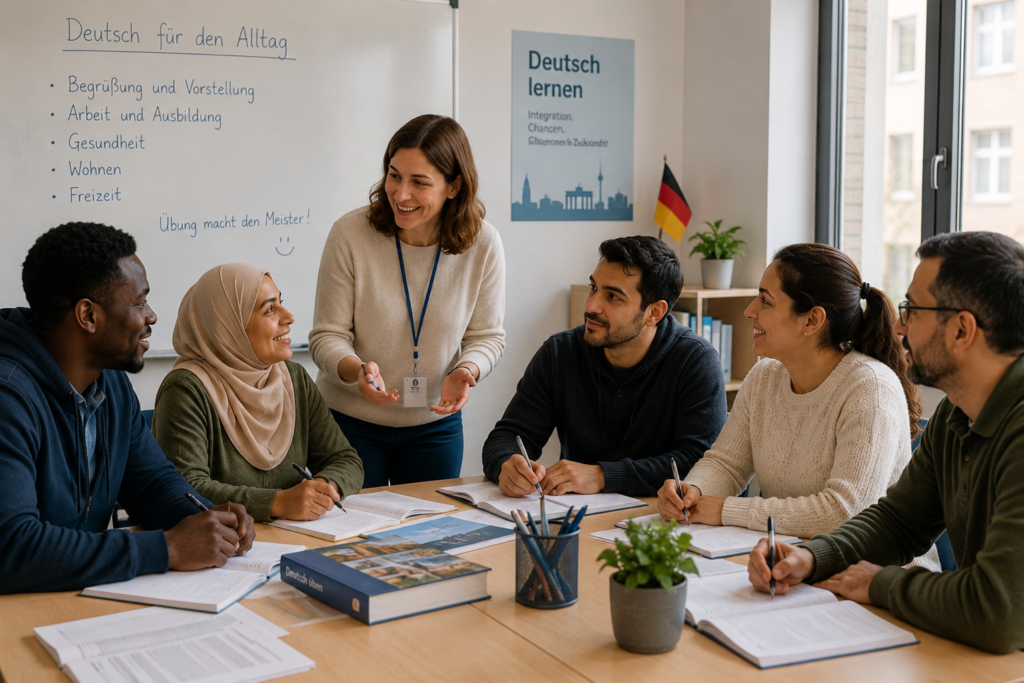
Germany’s Integrationskurs is a state-funded programme run by the Federal Office for Migration and Refugees (BAMF) and delivered largely through a national network of public adult education centres, the Volkshochschulen. It combines 600 hours of German language instruction with 100 hours of civics – society, history, the legal system – building towards B1 proficiency, tested via the DTZ exam. Attendance is tracked strictly: miss more than 30% of sessions and you don’t receive the certificate, even if you pass the test. It’s a substantial, structured commitment, nearly six times the contact hours typically available through UK ESOL provision, and BAMF funds the majority of the cost for participants.
The headline figures, from a recent Institute for Employment Research (IAB) study, are striking: 64% of the refugees who arrived in 2015 were in employment by the end of 2024, rising to 65–67% in 2026. This is only within a few percentage points of the national average, and among the highest such rates in Europe. Migration researcher Herbert Brücker attributes this directly to sustained investment in integration courses, language programmes and vocational training.
Crucially, this isn’t just correlation. A peer-reviewed study using the IAB-BAMF-SOEP Survey of Refugees found a causal link between the local supply of language courses and refugees’ probability of entering paid employment – evidence that provision, not just entitlement, is what drives outcomes. BAMF itself runs an ongoing large-scale evaluation (EvIk) tracking pass rates, progression and drop-out specifically among refugee participants, giving Germany an unusually rich evidence base to refine the programme over time.
The picture isn’t uniformly positive. The IAB data shows a stark gender gap: 76% of men from the 2015 cohort were employed by 2024, against just 35% of women – and course completion appears to be one of the strongest predictors of employment specifically for refugee women, making any restriction of access to courses a particular risk for closing that gap. Indeed, a more recent report describes rising anxiety among migrants after Germany tightened access to integration courses, a reminder that political mood can erode the very provision the evidence supports.
At a moment when the UK is weighing a national framework for ESOL against increasingly fragmented, devolved funding decisions, Germany’s experience is a useful data point: sustained, well-resourced language provision appears to pay measurable dividends in employment and integration over the long term – but only where access is protected, not eroded.
The Language of Change
15% on all 1-month and 3-month subscription courses this Halloween!