



‘Tailored learning’ features prominently in the Dept for Education’s recent ESOL stats. It’s the largest single slice of the DfE’s ‘non-regulated adult education’ category, accounting for 60.6% in the first half of 2025/26.[1] For ESOL, non-regulated provision is delivered almost entirely through courses with tailored learning aims, with negligible ESOL activity under other areas such as Skills Bootcamps.[1]
Tailored Learning replaced Community Learning in the DfE’s reporting from the 2024/25 academic year.[1] It sits within the Adult Skills Fund but is recorded separately from regulated qualifications, under ILR funding model 11 rather than the qualification-based funding model 38.[2]
The defining feature is that it’s not built around a qualification. It’s non-formula-funded, which gives providers flexibility to shape provision around learners, employers and local communities rather than a fixed curriculum leading to an exam. Its stated purpose, per DfE guidance, is to support progression into employment and further learning, but also softer outcomes such as wellbeing, confidence, and equipping parents to support their children’s learning.[1]
Learners record a ‘purpose’ for enrolling – one of seven categories, from improving essential skills to building confidence – and, since 2024/25, an ‘outcome’ once they leave.[1]
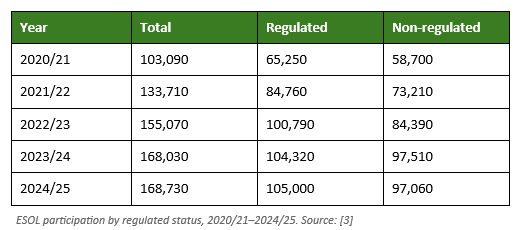
For ESOL specifically, DfE data presented at the NATECLA conference in June 2026 by Dr Philida Schellekens and the DfE’s Helen Guezelekuecuek shows 169,000 adult ESOL learners in 2024/25.[3] Of these, 105,000 are in regulated provision, 97,000 in non-regulated (tailored) provision, with 33,000 doing both. Total ESOL participation has grown 64% since 2020/21 — and non-regulated ESOL has grown slightly faster than regulated over that period, though both plateaued between 2023/24 and 2024/25.
This is where tailored learning looks quite different from the regulated ESOL landscape. Across all non-regulated education and training, local authorities deliver 45.3%, General FE Colleges 32.9%, and private providers 11.2% – very different to regulated qualifications, where colleges dominate (64.0%) and local authorities are a much smaller share (11.9%).[1] For ESOL specifically, General FE Colleges still account for the majority of all 19+ enrolments (60.4%), with local authorities at 32.3%[3] — but that LA share is disproportionately concentrated in the non-regulated, tailored end of provision. In practice, tailored ESOL is still substantially the old adult and community learning service, delivered close to the communities it serves, rather than the more exam-focused college offer.
Tailored ESOL enrolments in 2024/25 (54,690 total) break down as follows:
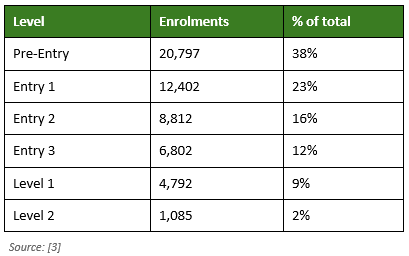
Sixty-one per cent of all tailored ESOL enrolments sit at Pre-Entry or Entry 1. Levels 1 and 2, broadly the point at which a learner has the fluency to operate in a skilled workplace or progress to mainstream vocational study, accounts for just 11% of tailored learning enrolments.[3] This mirrors the pattern in regulated ESOL, where the same low-level concentration holds. As stated above, tailored learning was designed with the flexibility to serve local and employer needs. In practice it’s clear that it overwhelmingly serves the earliest stages of language acquisition.
Approximately 50% of refugees have degrees, professional qualifications and experience.[4] It seems clear that there is significant opportunity for higher level tailored learning courses to be offered which focus on vocational ESOL and academic study.
Such courses, centring on the language needed in healthcare, finance, and the creative industries, for example, would help many settle more effectively into the UK, re-enter professions they know well and make greater contributions to their families, communities and the British economy. However, these courses are few and far between, so preventing many ESOL learners from making such a contribution, and leaving vast amounts of knowledge, experience and skill deeply under-utilised.
There is an issue with the data collected as it gives insufficient detail on whether tailored learning is meeting the needs of learners and achieving its stated aims. Participation and provider-type breakdowns are clear, but there’s no visibility into learner motivation, what happens after a course ends, or whether a learner’s language needs were actually met. The ‘outcome’ field introduced in 2024/25 is a start, but a third of enrolments in the current year have no outcome recorded yet, and the categories that do exist such as confidence and progression to further learning are self-reported and broad.[1] The Bell Foundation has separately called for a more detailed marker in the national learner record to track ESOL learners specifically across the whole system.[5]
Having better data would allow decision-makers to design programmes that meets learners’ needs across all levels – from pre-entry to Level 2. At higher levels, understanding the range of vocational needs on the one hand, and what exams learners need to pass to achieve professional registration or enter Further or Higher Education on the other, would enable ESOL providers to offer appropriately targeted tailored learning courses and fill what appear to be significant gaps in current course provision.
The Language of Change