


OET Speaking Role Card Analysis for Doctors
Back to Menu ↩ n the OET Speaking test, you receive your role card and have exactly 3 minutes to prepare before the role play
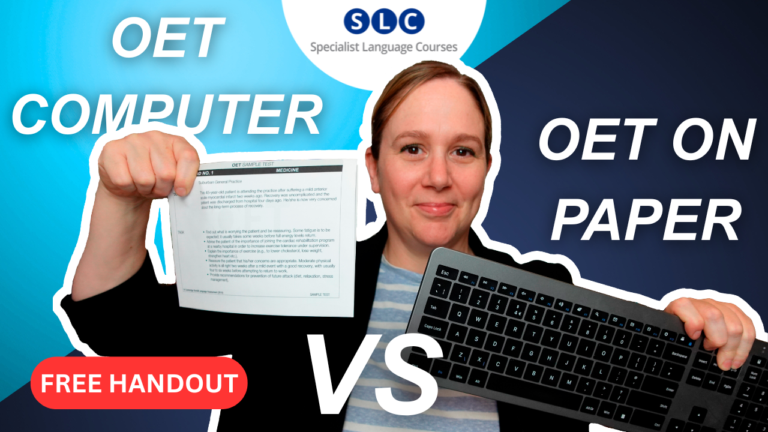
One of the most important decisions you will make before your OET exam is whether to sit it on computer or on paper — and choosing the wrong format for your strengths can directly affect your score. In this guide, we break down the real advantages and disadvantages of both formats so you can make a confident, informed choice.
Watch: OET on Computer vs Paper — Which Should You Choose?
Prefer to read? The full breakdown is below.
Editing your writing is quick and stress-free
The single biggest advantage of the computer-based format is how easy it is to organise and refine your writing. You can delete or move whole sentences, reorder paragraphs, correct grammar without messy crossings-out, and erase your planning notes in seconds before submitting. For many candidates, this flexibility alone significantly reduces the stress of the Writing sub-test.
Typing is faster than handwriting for most people
Even candidates who are not confident typists often find they can produce more words per minute on a keyboard than by hand. In the Writing sub-test, where time pressure is real and every sentence counts, this speed advantage can make a meaningful difference to the quality and completeness of your letter.
Built-in tools to support your performance
The computer-based test includes a word counter, a highlighting tool, and easy in-line editing. The word counter helps you manage length in the Writing sub-test without counting manually; the highlighting tool supports your reading and listening work during the exam. These are small advantages, but in a timed, high-stakes test they add up.
Faster results
Most computer-based candidates receive their results in around 6–10 days, and sometimes sooner. If you are working to a registration deadline or need to retest quickly, this faster turnaround is a significant practical benefit.
Speaking from home via Zoom
The computer-based Speaking sub-test can be taken at home over Zoom, which means you sit the exam in a familiar environment rather than a test centre. For candidates who find test centres stressful or who have limited access to a nearby venue, this is a genuine advantage — provided you meet the technical requirements (see disadvantages below).
The Zoom Speaking room check can feel stressful
Before the at-home Speaking sub-test begins, you may be asked to show your desk, the walls of the room, and what is behind and under your desk on camera. For some candidates this adds a layer of anxiety before they have even started speaking. Being well prepared for this check — knowing exactly what is expected — makes it much more manageable.
Internet and technical issues
A stable internet connection is essential for the at-home Speaking test. Technical problems — even ones that are not your fault — can be unsettling mid-exam. If your connection is unreliable, or if you live in an area with inconsistent broadband, this is a real risk to factor into your decision. The key is to stay calm if something goes wrong and follow the instructions you have been given.
No pen or paper during the Speaking sub-test
You cannot use paper or a pencil in the at-home Speaking test. Instead, you have access to a digital highlighting tool, which is explained in a 10-minute tutorial before the exam begins. If you rely heavily on written notes to prepare your responses during Speaking, this is worth practising in advance.
A familiar, traditional exam experience
For many candidates, sitting a test on paper simply feels more natural and more comfortable. There are no screens, no technical requirements, and no Zoom setup to worry about — just a pen and a question paper. If you feel more confident in a traditional exam environment, that confidence can have a positive impact on your performance.
Complete freedom to annotate
On paper, you can underline, circle, bracket, and write notes directly on the question paper. This is particularly useful in the Listening and Reading sub-tests, where marking up the text as you work through it can help you locate answers quickly and track your place. Many candidates find this physical engagement with the material supports their concentration.
Handwriting is slower — and legibility matters
For most candidates, handwriting is slower than typing. In the Writing sub-test, this means less time to develop your ideas or review your letter. There is also an additional consideration that does not apply on computer: if your handwriting is difficult to read, it can affect how your answer is assessed. Clear, legible handwriting is essential in the paper-based format.
Editing on paper is messy and time-consuming
Restructuring a paragraph, moving a sentence, or making a significant correction on paper takes time and can make your response harder to read. There is no easy delete — every change is visible. If your writing process involves a lot of revision and reorganisation, the paper format adds real friction.
Limited availability in some locations
Paper-based OET is not offered at every test centre, and in some regions it may not be available at all. Before deciding on this format, check what is actually offered in your area — you may find that travelling to a paper-based test centre is impractical, or that the scheduling options are more limited than for the computer-based test.
There is no universally correct answer — the right format is the one that plays to your strengths and minimises your vulnerabilities. Here is a simple guide:
Choose Computer if…
Choose Paper if…
Whichever format you choose, the most important factor is familiarity — practise in the format you intend to sit. If you are taking the computer-based test, practise typing your writing responses and using digital highlighting. If you are taking the paper-based test, practise handwriting under timed conditions and work on legibility.
Once you have chosen your format, the next step is a structured preparation plan. Our Reach OET B course is designed to take you from the basics of each sub-test all the way to exam readiness — regardless of whether you sit on computer or on paper.
Start Your Reach OET B Subscription →
Specialist Language Courses (SLC) is the UK’s leading provider of Medical English training, working with healthcare employers, education providers and individual learners in over 75 countries. Our OET courses are designed and taught by specialist tutors with deep expertise in healthcare English.
Specialist Language Courses (SLC) are dedicated to helping healthcare professionals excel in the OET. Our expert-led courses focus on the specific language skills and test strategies needed to succeed. With personalised coaching, practice tests, and targeted exercises, we ensure you build the confidence and competence required for each OET sub-test. Join SLC to boost your chances of achieving the scores you need and advancing your healthcare career

Back to Menu ↩ n the OET Speaking test, you receive your role card and have exactly 3 minutes to prepare before the role play

News · Partnerships & International Specialist Language Courses (SLC) is delighted to announce a new partnership with m2r Education to deliver a major new Teach

Back to Menu ↩ Already in the room The question is no longer whether AI tools will enter the medical English writing classroom. They already
Get updates and get the latest materials on Medical English, OET and IELTS