


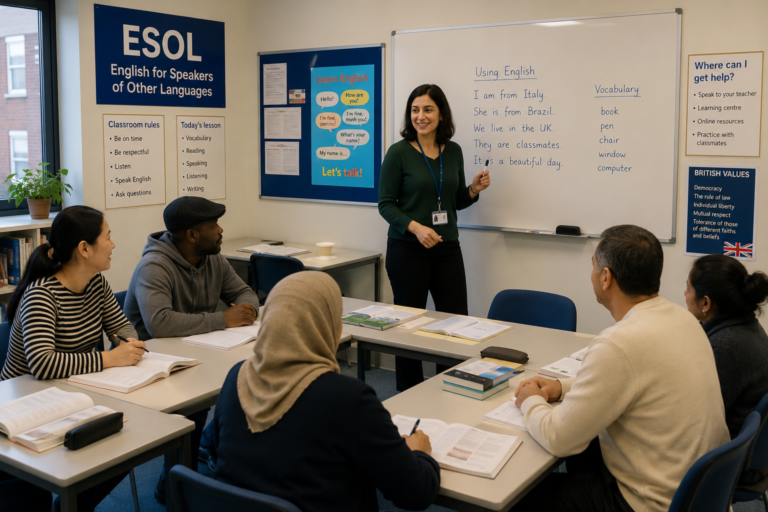

As the government raises the English language bar for migrants seeking to work and settle in the UK, serious questions are being asked about whether the ESOL sector has the capacity to help people meet it. The evidence, from a growing range of credible voices, suggests a widening gap between what is being asked of learners and what the system can realistically deliver.
The scale of the existing shortfall is striking. According to the Association of Colleges, demand for ESOL has grown by 17% since 2021, yet only 4% of adults in the UK who speak English as a second language are currently accessing ESOL classes. The sector is reaching a tiny fraction of those who need it and yet funding is moving in the wrong direction. Classroom-based adult education spending has fallen by two thirds since 2003/04, according to Institute for Fiscal Studies data, with a further 3% cut to the Adult Skills Fund in 2025/26.
Devolution is adding a new layer of fragmentation. As reported in last month’s newsletter, seven new mayoral areas took control of adult skills funding for the first time in 2026/27, bringing 77% of the national Adult Skills Fund under devolved control. While devolution brings opportunities, it also brings risk. Greater Lincolnshire Combined Authority has already confirmed it will scrap eligibility for funded ESOL courses from August 2027 – a decision the Bell Foundation’s CEO, Diana Sutton, warned could leave learners unable to access the English language support they need to participate in employment and community life.
NATECLA, the sector’s professional body, has been direct in its criticism. Responding to the ILR consultation, co-chairs Naeema Hann and Paul Sceeny described the proposals as ‘wrong-headed in principle as well as unworkable in practice’, arguing that higher language thresholds penalise those who have experienced forced migration, disability, caring responsibilities or low-paid work.
ACH, a refugee and migrant integration organisation, put it plainly in a January 2026 research paper: any increase in language requirements must be backed by sufficient funding and reform to ensure the required level of English is genuinely accessible — otherwise, higher thresholds risk increasing exclusion rather than promoting inclusion.

The employment consequences of inadequate provision are also well-evidenced. Research cited by the Bell Foundation shows a stark gap: adults who speak English well have a 78% employment rate — almost identical to first-language English speakers — while those with low English proficiency have an employment rate of just 35%.
Research published by the Learning and Work Institute, commissioned by MHCLG, reinforces the picture at grassroots level. It found strong overall ESOL availability in the South East but major gaps at pre-entry level, with long waits due to limited enrolment points — particularly affecting unaccompanied asylum-seeking children.
The APPG on Further Education and Lifelong Learning is currently taking evidence on adult education, with its report due in autumn 2026. Advocates, including the Bell Foundation, have called for a minimum ESOL entitlement in devolved budgets and a coordinated national strategy. Without one, the risk is that rising requirements and shrinking provision pull further apart — with real consequences for the people caught between them.
The Language of Change