



Knowledge Bank
Practising difficult conversations with an AI patient
Back to Menu ↩ Good doctors do not simply tell patients what to do. They explain the options, listen to the patient’s values and concerns,
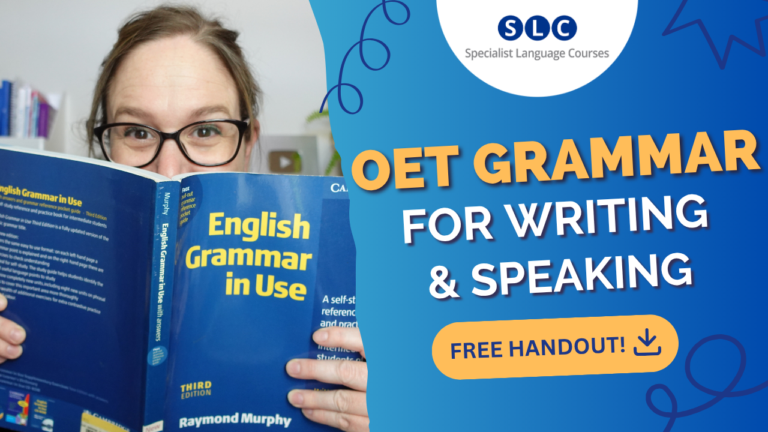
With so much focus on reading, listening, and communication skills, grammar can feel like an afterthought in OET preparation — but choosing the right structure at the right moment makes a real difference to your score in both Writing and Speaking. In this lesson, SLC tutor Jo shares five practical grammar structures that you can start applying in your very next practice test.
In this video, SLC tutor Jo walks you through five grammar structures that appear again and again in OET Writing and Speaking — and shows you exactly how to use them well. Each structure comes with clear rules, real examples from clinical contexts, and a practice activity with answers.
In the video, Jo covers:
Read on for a full written summary of everything covered, including all the practice exercises and answers.
OET grammar is not about impressing the assessor with elaborate sentences or advanced vocabulary. It is about choosing the right structure for the job — one that makes your meaning precise, your tone professional, and your communication effective. Grammar is directly assessed in both the Writing and Speaking sub-tests, where assessors look at range, flexibility, appropriateness, and accuracy of language.
Some structures also do more than convey clinical information — they help with relationship-building. Expressing empathy, softening advice, and phrasing requests tactfully all rely on grammatical choices. Getting these right shows the assessor that you can communicate as a professional, not just as a language user.
The three structures below are particularly valuable in the OET Writing sub-test, where clarity, conciseness, and a professional register are all being assessed.
Tense errors in OET Writing are common, and they almost always come down to the same confusion: past simple vs present perfect. The good news is that the case notes themselves usually tell you which one to use — you just need to know what to look for.
Use the past simple for a finished event at a definite time. If the notes give you a specific date or a finished time expression — “on 3 May”, “yesterday”, “last month” — that is your cue for past simple: was admitted, presented, underwent.
Use the present perfect for something that started in the past and is still relevant now. Time expressions like “since”, “for”, “over the past week”, and “recently” signal present perfect: has reported, has been, has improved.
Mr Adler was admitted on 3 May with chest pain. — past simple, because 3 May is a finished point in the past.
He has reported breathlessness over the past week. — present perfect, because the breathlessness is ongoing.
She has smoked 20 a day for 30 years. — present perfect, because she still smokes now.
Train yourself to scan for time markers first, and the tense decision becomes automatic.
The passive is prevelant in professional medical writing. It keeps the focus on the patient and the care being provided, rather than on “I” or “we”, and it produces the formal register that OET Writing rewards.
The form is straightforward: the verb be plus the past participle of the action verb. But the most effective way to learn the passive for OET is not to learn the rule in isolation — it is to learn key clinical phrases as complete chunks, with their prepositions built in.
Learning the preposition as part of the phrase means these constructions come out accurately under exam pressure. Many of them can also be adapted across different clinical contexts, so they are worth memorising as reusable building blocks.
Relative clauses allow you to join two pieces of information into one smooth, concise sentence. This is exactly what OET Writing rewards — the ability to express clinical facts clearly and efficiently without a string of short, choppy sentences.
Use who for people, which for things, and where for places.
❌ Mr King has hypertension. He takes Ramipril for this.
✓ Mr King has hypertension, for which he takes Ramipril 5mg.
❌ Mrs Patel presented with worsening symptoms. She was diagnosed with osteoarthritis in 2015.
✓ Mrs Patel, who was diagnosed with osteoarthritis in 2015, presented with worsening symptoms.
Notice how much more controlled and professional the relative clause versions read. That is the quality of writing the assessors are looking for.
In the Speaking role-play, grammatical accuracy matters — but so does appropriateness. The two structures below are particularly valuable because they help you communicate empathy and advice in a way that sounds natural and professional, not scripted or blunt.
OET Speaking assessors listen for explicit, verbal empathy — and must and can’t are one of the most natural ways to express it. When you use must, you are telling the patient that you are fairly sure something is true based on what they have shared. When you use can’t, you are expressing the opposite — that something cannot be easy, or cannot have been straightforward.
For a present situation, use must/can’t be with an infinitive: That must be worrying. That can’t be easy. For a past situation, use must/can’t have been: That must have been frightening. That can’t have been easy for you.
Managing this on your own — that must be exhausting.
Waiting for those results must have been very stressful.
That can’t have been easy, caring for him on your own.
When you name what the patient must be feeling, you show you have really listened — and that is precisely what the Speaking assessors are rewarding.
OET Speaking role cards almost always ask you to advise or persuade the patient in some way. The key is to sound helpful and professional rather than bossy — and the modal you choose signals exactly how firm the advice is.
Think of advice modals on a scale from softest to firmest:
You might want to think about keeping a symptom diary. — lifestyle suggestion, so a gentle modal is appropriate.
You should come back straight away if the swelling gets worse. — a safety concern warrants a firmer modal.
If you experience any difficulty breathing, you must go to the emergency department. — potentially life-saving, so the strongest modal is right.
Grading your advice in this way shows the assessor that you understand not just the language, but the clinical context it sits in.
Specialist Language Courses (SLC) are dedicated to helping healthcare professionals excel in the OET. Our expert-led courses focus on the specific language skills and test strategies needed to succeed. With personalised coaching, practice tests, and targeted exercises, we ensure you build the confidence and competence required for each OET sub-test. Join SLC to boost your chances of achieving the scores you need and advancing your healthcare career
Back to Menu ↩ Good doctors do not simply tell patients what to do. They explain the options, listen to the patient’s values and concerns,

Back to Menu ↩ Metaphors can tell us a lot about how people think. A new study, published in Acta Psychologica, uses metaphors to explore

Back to Menu ↩ In many countries, a large part of the healthcare workforce has trained overseas. In the UK for example, international medical graduates
Get updates and get the latest materials on Medical English, OET and IELTS