Specialist Language Courses

Translanguaging in medical English: what the research says now

Multilingual teamwork in medical English

Most people who learn medical English are already multilingual. Medical students in Riyadh, Ho Chi Minh City or Tashkent study medicine in English but speak to patients in Arabic, Vietnamese or Uzbek. Internationally educated nurses and doctors preparing for OET often use two or three languages every day at work. Many of their future patients will be multilingual too. 

Yet many medical English classes still follow an ‘English only’ rule. OET preparation may emphasise this, because the test itself is entirely in English. Translanguaging challenges this habit. This article looks at what it means, what the recent research says, and how teachers might use it. 

What translanguaging means in a medical English classroom

The term began in Wales when, in 1994, Cen Williams used the Welsh word trawsieithu to describe bilingual teaching. Later, Ofelia García and Li Wei developed the idea into an international theory. In simple terms, translanguaging means that teachers treat all of a learner’s languages as a resource for learning, seeing them as an asset, not as a problem. Jasone Cenoz and Durk Gorter use the term pedagogical translanguaging for planned use of this kind by teachers. 

The debate on whether translanguaging is effective is not new. In 2012, for example, Graham Hall and Guy Cook reviewed the research on ‘own-language use’ in Language Teaching. They argued that the long tradition of English-only teaching had rarely been tested against evidence, and that learners’ own languages can support learning. 

In a medical English class, translanguaging might include: 

  • comparing how medical terms are formed in English and in learners’ languages, since many languages share Greek and Latin roots 
  • bilingual glossaries that include both technical terms and the everyday words that patients use 
  • discussing OET case notes in a shared language before writing the letter in English 
  • comparing how bad news, consent or pain are discussed in different languages and cultures 
  • asking learners how they would explain a diagnosis to a patient at home, and then to a patient in an English-speaking environment 

None of these activities replaces English as the goal. The aim is to help learners reach that goal by building on what they already know and widening the resources that teachers can draw on.  

What recent research shows

Research on translanguaging in medical and healthcare education is still small, but it is growing. 

  • Saudi Arabia (2026). Muhammad Alasmari and Obied Alaqlobi surveyed 90 medical students and interviewed 10 more, in a university where medicine is taught in English (BMC Medical Education). Students felt that using Arabic alongside English helped them understand complex content and communicate better. However, the study also found a risk. Students who relied heavily on Arabic were less confident with English medical terms and less willing to use English. The authors recommend clear guidelines, teacher training, bilingual materials and translanguaging in clinical simulations. 
  • Vietnam (2026). Huynh and Huynh observed one ESP medical English class in Ho Chi Minh City for 12 weeks. The teacher used Vietnamese for five purposes: explaining concepts and terms, checking understanding, linking content to Vietnamese healthcare, clarifying tasks, and building rapport. The most common use was explaining terminology. The authors report that this supported understanding, engagement and confidence. It is a single-class study, however. 
  • China (2026). Pan and Fang compared students’ engagement in English-only classes and in classes where teachers used translanguaging, in an English-medium university in China (Humanities and Social Sciences Communications). Over 200 students reported higher engagement in the translanguaging classes. The students were not medical students. However, the non-English majors in the study especially valued their first language for understanding subject-specific terminology. 
  • United States (2025). In a nursing course, Jan Oosting allowed students to write some assignments in their strongest written language (Journal of Nursing Education). Three of nine students chose to do this, and they described it as empowering. 

Two patterns are clear. First, most of the benefits reported are for comprehension, confidence and engagement. No study yet measures gains in medical English proficiency or test scores. Second, the Saudi study shows that while learners’ first languages can help them understand medical English, heavy reliance on them may slow the move to using English independently. 

Translanguaging in clinical practice

Translanguaging also happens in real healthcare. This matters for teachers because it shows the kind of language that learners will meet at work. 

In Perspectives on Medical Education, Pilar Ortega and Josh Prada argue that medical communication training should reflect how patients really speak. Spanish-speaking patients in the United States often mix English and Spanish, for example by saying ‘refill’ in a Spanish sentence. A word as simple as ‘straw’ has several different Spanish words, depending on where the patient comes from. The authors suggest including these ‘translanguaging moments’ in simulated patient cases. 

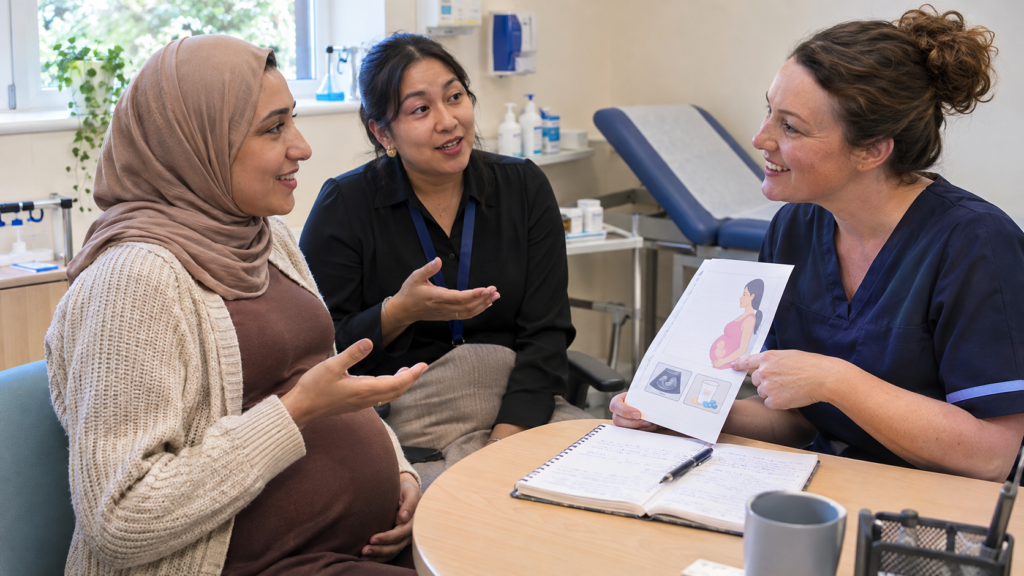
In the UK, a doctoral study by Emma Brooks at UCL looked at antenatal appointments in a hospital in south London. When no professional interpreter was present, midwives and patients used every resource they had: words from different languages, gestures and written notes. This helped communication happen. But it could also hide the fact that a patient had not fully understood. 

This is an important point for healthcare learners. A clinician’s other languages are a real asset. They are not, however, a replacement for a professional interpreter when clinical safety is at stake. 

Bridging languages in antenatal care

A practitioner-researcher’s view

Graham Seed, a teacher and researcher at Cambridge University Press and Assessment who has studied translanguaging, offers practical advice that applies well to medical English. 

  • Planned spontaneity. Translanguaging can be planned or spontaneous. Seed suggests teachers prepare to use learners’ languages when the moment calls for it. 
  • Genuine and strategic translanguaging. Genuine translanguaging is the natural use of words from other languages, such as the local name for a traditional remedy. Strategic translanguaging is the deliberate use of other languages to learn English, for example through translation or comparison. Genuine translanguaging works at every level. Strategic translanguaging may be most useful at lower levels. 
  • Teachers don’t need to speak learners’ languages. It helps, but it is not necessary. Teachers often worry about what learners are saying, but in most cases there is no need. 
  • The main challenge is confidence. Teachers may feel that using other languages is not ‘correct’ or breaks institutional policy. Seed’s advice is to be clear about why you are using translanguaging at each moment. 

What about OET?

OET candidates must perform in English, under time pressure, without any support from other languages. So translanguaging in OET preparation should be a means, not an end. In practice, this suggests: 

  • using learners’ languages early in a course, and for understanding and planning, for example to analyse case notes or discuss a role-play scenario 
  • keeping all final performance in English: the letter, the role-play and the test practice 
  • reducing support from other languages as the test date gets closer 
  • using comparisons between languages to help learners notice problems, such as false friends, register and how directly to give advice 

What this means for teachers and course designers

The evidence does not show that translanguaging necessarily raises medical English proficiency. However, it does suggest that careful, planned use of learners’ languages can support understanding and confidence which will have a positive impact on student motivation and willingness to engage in lessons.  

For teachers: 

  • Plan when other languages help (understanding terms, preparing tasks, comparing cultures) and when the focus is English. 
  • Explain the approach to learners, so it is a shared strategy and not something hidden. 
  • Watch for over-reliance, especially with medical terminology. 

For course designers and institutions: 

  • Review ‘English only’ policies and ask whether they are based on evidence. 
  • Encourage collaboration between language teachers and clinical teachers. A 2026 Finnish study of nursing education for migrant students found that this collaboration was central to integrating language and professional learning. 
  • Include ‘translanguaging moments’ in simulations and standardised patient cases. 

While research is still to be further developed, it does seem that the question is no longer simply whether other languages belong in the medical English classroom. It is more how teachers can use them effectively. 

References

Alasmari, M., & Alaqlobi, O. (2026). A SWOT analysis of translanguaging in healthcare education: Overcoming language barriers for future professionals. BMC Medical Education, 26, 104. Alasmari & Alaqlobi (2026), BMC Medical Education 
Brooks (2020). Translanguaging health: Navigating antenatal consultations in a superdiverse setting [Doctoral thesis]. UCL Institute of Education. Brooks (2020), Translanguaging health – UCL thesis 
Cenoz, J., & Gorter, D. (2021). Pedagogical translanguaging. Cambridge University Press (Cambridge Elements). Cenoz & Gorter (2021), Pedagogical Translanguaging 
García, O., & Li Wei (2014). Translanguaging: Language, bilingualism and education. Palgrave Macmillan. 
Hall, G., & Cook, G. (2012). Own-language use in language teaching and learning. Language Teaching, 45(3), 271–308. Hall & Cook (2012), Language Teaching 
Huynh, G. H., & Huynh, V. T. T. (2026). Translanguaging practices in a Vietnamese ESP medical classroom: A qualitative case study. International Journal of Linguistics and Translation Studies, 7(2), 110–124. Huynh & Huynh (2026), Vietnamese ESP medical classroom 
Oosting, J. (2025). Translanguaging in the undergraduate nursing classroom: An educational innovation. Journal of Nursing Education, 64(5), 327–330. Oosting (2025), Journal of Nursing Education 
 
Ortega, P., & Prada, J. (2020). Words matter: Translanguaging in medical communication skills training. Perspectives on Medical Education, 9(4), 251–255.  
Pan, X., & Fang, F. (2026). Translanguaging pedagogies and student engagement in English-medium instruction classrooms. Humanities and Social Sciences Communications, 13, 1325. Pan & Fang (2026), Humanities and Social Sciences Communications 
Repo Jamal, H., Elomaa-Krapu, M., & Koivisto, J.-M. (2026). Core elements of functionally bilingual nursing education: A descriptive qualitative study. Nurse Education in Practice, 94, 104849. Repo Jamal et al. (2026), Nurse Education in Practice 
More To Explore
Peter Rodway
News
SLC expands into Uzbekistan

Partnerships · International SLC director Peter Rodway recently spent a week in Uzbekistan, meeting university leaders, lecturers and students to explore opportunities for Medical English

Read More »

Subscribe to our newsletter

Subscribe to the newsletter to keep up to date with all our new resources.