

Specialist Language Courses

Vocational ESOL – what is it and why we need it more than ever

ESOL cover

Vocational ESOL focuses on the language that migrants and refugees need when working in the UK.

Different sectors require different language – different conversations, different vocabulary, different skill sets. Vocational ESOL builds learners’ abilities to engage and thrive at work – from social care to accounting to construction to hospitality, marketing, HR, pharmacy, nursing and medicine.

Think about it. A social carer talking to a care home resident is a very different language exchange to an accountant presenting a company report. General ESOL courses are useful in building a foundation in English but they don’t include, for example, how to reassure an upset and confused patient, check for pressure ulcers, or encourage someone to mobilise. This where vocational ESOL comes in.

What is vocational ESOL?

Vocational ESOL focuses on specialist, practical learning. Courses include professional and technical language, and workplace-specific communication with customers, colleagues, patients, and clients. The language is therefore high context and often high stakes. Getting it wrong can have serious consequences, compromising safety, care and important relationships.

Vocational ESOL is also very wide-ranging covering a variety of language used at different levels of competency. In healthcare, for example, the language needs of doctors, nurses, pharmacists, carers, physiotherapists, dentists and social workers may be quite different. Some may also need to take exams such as OET, PLAB, or the OSCE as part of their professional registration.

Why teach vocational ESOL?

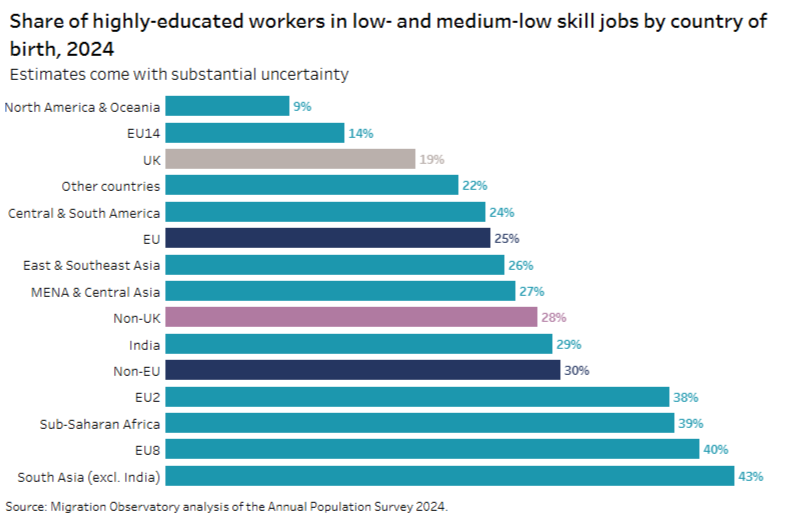
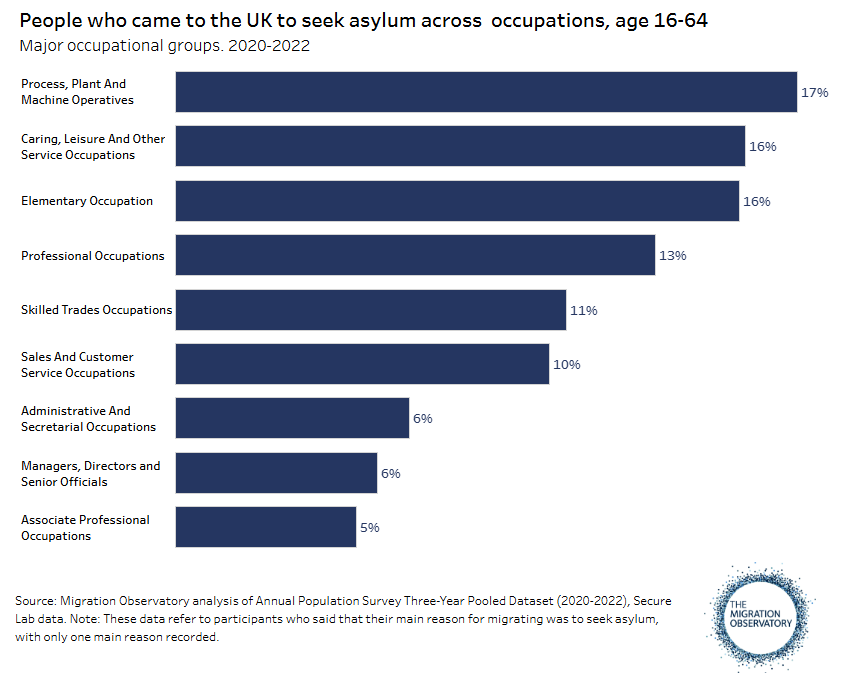
Among migrant and refugee communities there are vast untapped pools of talent held back by language. A 2025 report by the Migration Observatory showed large numbers of highly-educated workers in low- and medium-low skilled jobs. A 2024 report showed significant numbers of those coming to the UK to seek asylum now work in low-skilled sectors. Imagine the contribution that could be made if we were to match skilled workers with the jobs they were trained to do – to them and their well-being, to their families and communities, and to the Exchequer’s coffers via the tax they pay.

Migration Observatiory analysis of the Annual Population Survey 2024
Migration Observatiory analysis of the Annual Population Survey 3-year pooled dataset

High skills vocational ESOL

At SLC, we teach experienced doctors working in care assistant roles, finance professionals working in factories and teachers serving coffees. So often it is English language skills – and the confidence one gets when speaking language well – that holds these learners back. This is where vocational ESOL can make a difference. A doctor can acquire the skills to take OET and PLAB so they can register with the GMC, an accountant can learn the language they need to prepare for their AAT or ACCA professional exams, and teachers can learn the language they need to manage classrooms, motivate learners and explain complex subjects.

Lower-skills vocational ESOL

Vocational ESOL is not only for highly educated refugees and migrants. There are thousands of opportunities to work in social care – over 100,000 vacancies at present – and construction as the government aims to build 1.3 million new homes. Both sectors require workplace-specific vocational language to provide empathic care or ensure safety at work and to be part of a team.

Vocational ESOL at the South West ESOL Conference

Chris Moore, SLC’s Managing Director, recently presented at the South West ESOL Conference on vocational ESOL. He focused not only on what it is and why it matters. He also discussed the challenges vocational ESOL providers face when working with migrant and refugee learners who may come from very different cultures, have had deeply traumatic journeys to the UK, and be dealing with ongoing uncertainties as they study and look for work. And finally, he looked at what teachers and education providers need to consider when designing and delivering vocational ESOL courses.

Vocational English and SLC

Bridging the gap between what learners need and what resources are available for teachers to draw on – needs analysis, teaching materials, professional development – is essential to improving the provision of vocational ESOL across the UK.

At SLC, we are developing a suite of courses designed to address this need, including both tuition and published materials – all online, so enabling us to meet challenging shift patterns, uncertain living ccircumstances, and geographically dispersed learners and do it at scale.

We work with strategic migration partnerships, local authorities and education providers. If you’d like to discuss how we can support your vocational ESOL needs, please contact Chris:

More To Explore