





SLC partners with m2r Education on new Teach English in Uzbekistan programme
News · Partnerships & International Specialist Language Courses (SLC) is delighted to announce a new partnership with m2r Education to deliver a major new Teach
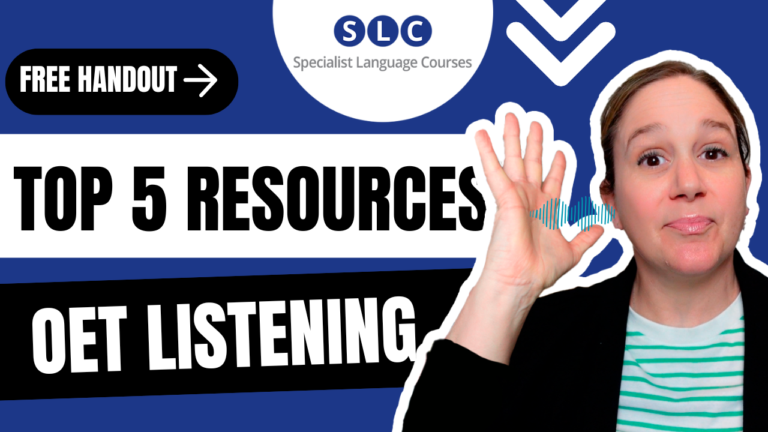
Fast speech, unfamiliar accents, and losing your place in Part C — the OET listening paper presents challenges that require targeted, consistent practice to overcome. In this guide, we share five of the most effective resources for OET listening preparation, along with specific activity ideas so you know exactly how to use each one.
Prefer to read? Keep scrolling for the full written guide.
The OET listening paper tests a range of skills — listening for detail, understanding paraphrasing, identifying attitude and opinion, recognising signposting language, and following extended discourse in Part C. The resources below each target different aspects of these skills, and we have included practical activity ideas throughout so you can make every study session count.
The OET website is your essential starting point. Under the Preparation section you will find sample tests in both computer-based and paper-based formats, a dedicated listening tab with an overview video, complete guides to Parts A, B and C, and a library of blog posts on improving your listening skills.
The five downloadable paper-based practice tests give you authentic exam material — but there is far more value in them than a simple timed run-through. Here is how to use them across the different stages of preparation:
Activity idea — understanding paraphrasing: After completing a Part A listening, compare the transcript with the question paper side by side. Find every example where the notes use different language from what the speaker actually said. For example, the notes may read sweating heavily while the speaker says sweating buckets, or the notes say persistent vomiting while the speaker says I haven’t been able to keep anything down. Collecting these pairs builds the paraphrasing recognition skill that is central to Parts A and B.
Activity idea — vocabulary development: Use the transcript to identify informal or colloquial patient language. Phrases like splitting headache, my heart was really racing, and throwing up are the kind of expressions you need to recognise quickly under exam conditions.
Activity idea — following Part C: Losing your place in Part C is one of the most commonly reported problems. Use the transcript to highlight the phrases that signal a move to the next topic or question — signposting language such as moving on to, another key point, or what this means in practice. Highlight these with a pen so you can train your ear to listen for them.
The ABC Health Report is an Australian podcast series covering a wide range of healthcare topics, with episodes that match the register and complexity of OET listening material. Each episode comes with a description of the topics discussed and, crucially, a full transcript — making it an ideal resource for both listening and language development work.
Activity idea — listening for main ideas: Before you press play, read the episode description and use it to predict the topics you expect to hear. Then listen and take notes on the main ideas discussed for each topic. Afterwards, check your notes against the transcript.
Activity idea — vocabulary and language of opinion: Use the transcript to identify words and phrases that express the speaker’s attitude or opinion. Note how language changes when a speaker is presenting a fact versus expressing a view. This directly mirrors the attitude and opinion questions in OET Part B and C.
Tip: Choose episodes that relate to your own professional area — you will find the vocabulary more familiar and the listening more manageable, which builds confidence alongside skill.
GPs Behind Closed Doors is a UK documentary series that follows day-to-day GP consultations. Because it features real healthcare professionals and real patients speaking naturally — with all the hesitations, informal expressions, and rapid pace that entails — it is one of the best resources available for training your ear to handle authentic medical English.
Full episodes are available on the Channel 5 website (free registration required for UK viewers), and many clips are also available on YouTube for international candidates.
Activity idea — listening for detail: Choose a short clip and set yourself a specific listening task before you press play. For example: write down every question the doctor asks, note all the words the patient uses to describe their symptoms, or list any medication names mentioned. Focused listening like this trains the detail-level accuracy that Part A demands.
Activity idea — understanding natural speech: Watch the same clip a second time and notice the features of fast, natural speech — sounds that are reduced, words that link together, or phrases that are contracted. Compare what you thought you heard the first time with what was actually said.
TEDMED publishes talks on medical and health research by clinicians, scientists, and public health experts. The register — formal, evidence-based, and often complex — closely matches the kind of extended discourse you encounter in OET Part C, making it excellent preparation for the most challenging section of the listening paper.
Activity idea — structured note-taking: Before watching, read the talk description and use it to predict the topics that will be covered. Then watch and write down the main topics discussed. Watch again and add more detailed notes under each topic heading. This two-pass approach mirrors the kind of active listening you need to sustain through a Part C recording.
Activity idea — signposting language: As you watch, note every phrase the speaker uses to move from one point to the next — expressions like building on this, a further consideration is, or to give you an example. A strong awareness of signposting language is one of the most reliable ways to avoid losing your place in Part C.
Activity idea — checking comprehension: After you have listened once, turn on the closed captions (click the CC symbol and select English) and watch again to check your notes against what was actually said. Use any gaps as vocabulary development opportunities.
The four free resources above will take you a long way — but if you want a complete, structured programme that covers every part of the OET listening paper systematically, our Reach OET B course brings it all together.
The listening section of the course includes:
Subscriptions are available for one month or three months, and can be combined with one-to-one tuition if you want personalised feedback on your performance.
These free resources are powerful — but using them without a clear framework can slow your progress. Our Reach OET B course gives you a structured path through every part of the reading paper, with expert guidance on which skills to prioritise and when.
Here is a simple framework for combining all five resources across your preparation:
Specialist Language Courses (SLC) are dedicated to helping healthcare professionals excel in the OET. Our expert-led courses focus on the specific language skills and test strategies needed to succeed. With personalised coaching, practice tests, and targeted exercises, we ensure you build the confidence and competence required for each OET sub-test. Join SLC to boost your chances of achieving the scores you need and advancing your healthcare career
News · Partnerships & International Specialist Language Courses (SLC) is delighted to announce a new partnership with m2r Education to deliver a major new Teach

Back to Menu ↩ Already in the room The question is no longer whether AI tools will enter the medical English writing classroom. They already

Back to Menu ↩ A concept whose time has come There is a phrase that has been quietly reshaping workplace learning and development over the
Get updates and get the latest materials on Medical English, OET and IELTS