

Specialist Language Courses

English language requirements for nurses: a country comparison

Nurse in hospital with patient

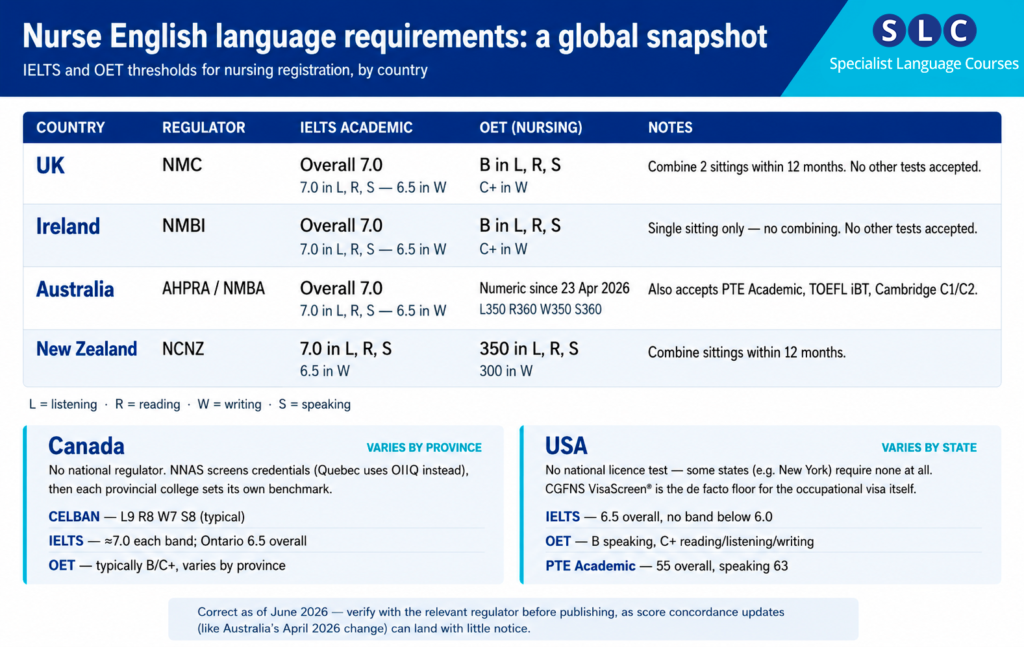
UK, Ireland, Australia and New Zealand

These four countries each have a single national nursing regulator, so their requirements compare directly.

nurse_english_requirements_comparison

Canada — regulated province-by-province

There is no single national nursing regulator. Every province (except Quebec, which uses OIIQ) routes applicants through the National Nursing Assessment Service (NNAS) first, then its own provincial college sets the final English benchmark. Typical figures:

  • CELBAN (most common provincial benchmark): Listening 9, Reading 8, Writing 7, Speaking 8
  • IELTS Academic: most provinces require approximately 7.0 in each band; Ontario is the notable outlier at 6.5 overall (no band below 6.0)
  • OET: typically B in Speaking/Listening, C+ in Reading/Writing, though this varies by province
  • Also accepted in most provinces: PTE Academic

USA — no single national licence requirement

Nursing licensure is set state-by-state, and some states — New York is the clearest example — require no separate English test at all, treating a pass on the NCLEX-RN exam (which is in English) as sufficient proof. However, almost every internationally-educated nurse will still need CGFNS VisaScreen® certification to obtain the actual occupational visa, regardless of state, which functions as the de facto national floor:

  • IELTS Academic: 5 overall, no band below 6.0
  • OET: B in Speaking; C+ in Reading, Listening and Writing
  • PTE Academic: overall 55, no section below 50, except Speaking 63
  • Exempt if trained in English in: the UK, Australia, Canada (except Quebec), New Zealand, Ireland, the USA, or Trinidad & Tobago

Reference:

NMC, NMBI, AHPRA/NMBA, Nursing Council of New Zealand, NNAS and provincial nursing colleges, CGFNS International. Compiled for Medical English in Focus — Specialist Language Courses.

Did you find this content valuable?

Subscribe to the Medical English Newsletter to receive monthly updates, insights, and resources on Medical English.

More To Explore