

Does learning languages really prevent dementia?
Back to Menu ↩ Many of in the language teaching profession have used this claim at some point: learning a language is good for your brain. It
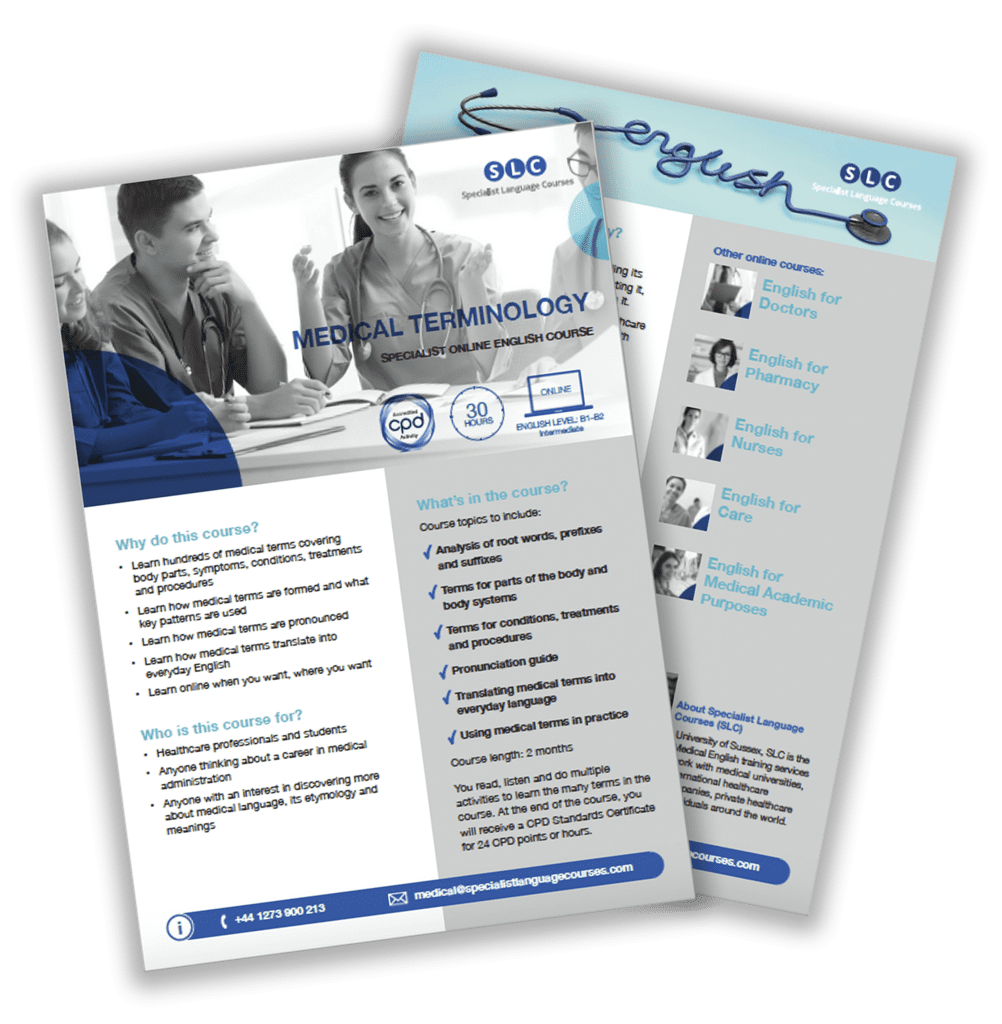
This online Medical Terminology course introduces hundreds of medical terms covering body parts, symptoms, conditions, treatments and procedures. It also shows how medical terms are formed and pronounced, and how they translate into everyday English.
Medical terminology is essential to understanding healthcare. Using an agreed set of medical terms allows healthcare students to use language that will be understood by healthcare teachers and professionals wherever it is said or written.
The course analyses the roots of medical terms – very often derived from old English, Latin or Greek – and the prefixes and suffixes which combine with the roots to give specific meanings, so enabling students to understand new terms when they see them for the first time.
The course covers terms for every part of the body, from the parietal bone to the sacrum to the hallux.
This course provides strong support to courses given by medical English teachers which focus more on learning and practising subject-specific language and patient interactions.

Back to Menu ↩ Many of in the language teaching profession have used this claim at some point: learning a language is good for your brain. It

Back to Menu ↩ Support for internationally recruited nurses usually stops early. There is a registration process, a language test, an induction programme, and then an

Back to Menu ↩ In medical English classes, we often discuss language barriers in one direction. Whether it be moving overseas for work, attending conferences,
Subscribe to the newsletter to keep up to date with all our new resources.