Specialist Language Courses
medical English courses

Lesson Plan: Greeting Patients

Lesson Plan: Greeting Patients

Share This Post

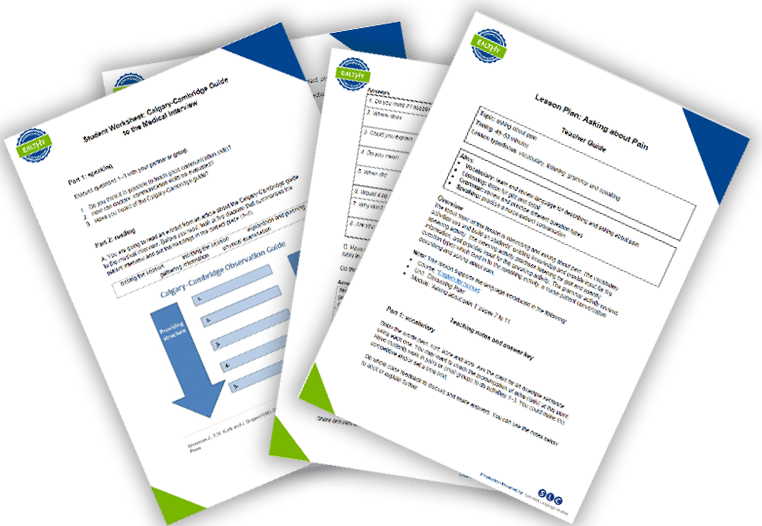
This lesson plan examines different ways in which a doctor can greet patients.

B2 level

Teacher Notes

●      Topic: Patient admission – greeting a patient

●      Timing: about 30 minutes

●      Lesson Type/Focus: speaking & reading 

Aims

●      Speaking: discuss and reflect on the different ways to greet a patient

●     Conversation analysis: review a conversation for appropriate language and responses. Re-write conversation to make more appropriate

●      Reading: rguided group research and discussion on the topic of greeting patients

Overview

The focus of this lesson is greeting a patient. The discussion activities encourage students to reflect on practices in their own context and country. The reading activities give an insight into practices in the UK. The conversation analysis/functional language section gives students input and practice in choosing appropriate phrases for greeting a patient.


Note: this lesson uses material from SLC’s course, ‘English for Doctors: Advanced Communication Skills’.

Teaching Guide & Answer Key

Part 1: discussion

Put students into small groups to discuss the questions.
Re-group students and ask them report on the ideas from their group to their new groups. Open up to whole class and continue to discuss.

Suggested answers

  1. What is important when greeting a patient? Think of 3 top tips.
    Tell the patient your name, explain your role, think about effect of using first or last name
  2. What are your experiences of greeting patients?
    Students’ own answers
  3. In your context, how do you think patients prefer to be addressed? Why? (Think about age, cultural background, role of healthcare professional).
    Students’ own answers

Note: If students have not had much experience in a patient-facing role, encourage them to also consider the questions from a patient perspective.

Part 2: greeting patients and explaining your role

Error correction activity. Students work individually or together to find the mistakes in each sentence.

Answers

  1. Hello. My name is Dr Rogers. I’m the doctor in on duty today.
  2. I am responsible to for the surgical patients on this ward.
  3. This means I look out for after patients who have just had an operation.
  4. I am the surgical F1 in on call today.

Download the complete lesson plan and student worksheet:

Want more lesson plans?

Lesson Plans

We have many more available on our partner’s website. EALTHY is a unique international association for
English for Healthcare teachers, writers and researchers. It offers members a growing bank of lesson plans, OET resources, articles and research summaries, as well as free and discounted access to conferences, journals, publications and SLC courses!


Through our partnership, we publish at least three new plans in the EALTHY Members Area every week. So, if you’re a teacher looking for excellent resources, now is the time to join an international English for Healthcare community and take advantage of everything EALTHY has to offer.


Annual memberships are available for teachers and for institutions. We hope very much to see you there!

Subscribe to our newsletter

Get your monthly updates and latest materials on Medical English

More to explore
Cystic Fibrosis

Lesson Plan: Developments in the treatment of Cystic Fibrosis

Lesson Plan: Developments in the treatment of Cystic Fibrosis

Cystic Fibrosis
Share This Post

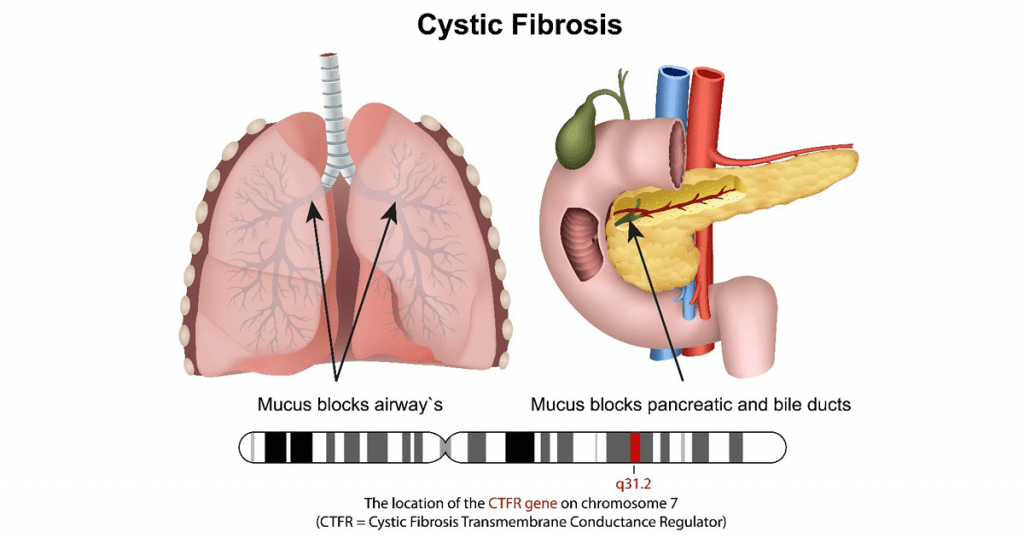
This lesson plan analyses an article on a new cystic fibrosis drug and teaches associated vocabulary.

B2-C1 level

Teacher Notes

What do you know about CF?

  • The term cystic fibrosis comes from:

cystic: describing a cyst, from the Greek word kystis which means bladder or pouch. In the case of CF, the cysts form in the pancreas.

fibrosis: fibrous growth in an organ (in the case of CF, in the pancreas)from the Latin word fibra which means a fibre or filament.

  • CF was recognised as a specific disease by Dorothy Hansine Andersen, an American pathologist and paediatrician in 1938, although descriptions of the condition are evident from the late 16th century.

Language Focus

  • Language Focus 1: Adjectives with life

life-extending: helping people live longer

life-shortening: condition which causes people to have a shorter life than the average person

life-threatening: condition which may cause a person to die

life-affirming: something which makes you feel glad to be alive

lifespan: the period of time that a person exists

lifetime: the period of time something or someone exists (I’ve seen many changes in my lifetime)


  • Language Focus 2: describing death

fatal: something which is able to cause death (I a fatal illness) or a serious consequence (a fatal flaw in the design of the building)

mortal: something that causes deathe.g. a mortal blow to the head

lethal: something which is specifically designed to cause death, e.g. a lethal injection to execute someone

terminal: likely to cause death, often used to describe the end stages of an illness, e.g. terminal cancer

deathly: something which resembles death, e.g. a deathly pallor (very pale skin)

Now, read the article and answer the questions.

1. Why do people with CF require frequent hospitalisation?

2. Why might the new drug be ‘good for taxpayers and patients’?

3. What is a ‘green light’? What other expression do you know with the same meaning? 

Cystic Fibrosis

Cystic fibrosis drug given green light in England

life-extending drug for cystic fibrosis will be available on the NHS in England, health bosses say.

NHS England reached a deal with the manufacturers of Orkambi, Vertex Pharmaceuticals, after months of negotiations. Patients should be able to get the drug within 30 days.

The drug improves lung function and can be given to children as young as two.

The firm wanted to charge £100,000 per patient per year, but a compromise has been reached in a confidential deal.

It is understood to be significantly less than the sum originally asked for.

It comes after the Scottish Government reached an agreement with the manufacturers last month.

Wales and Northern Ireland can also access the drug under the same terms negotiated by NHS England.

Download the complete lesson plan and student worksheet:

Want more lesson plans?

Lesson Plans

We have many more available on our partner’s website. EALTHY is a unique international association for
English for Healthcare teachers, writers and researchers. It offers members a growing bank of lesson plans, OET resources, articles and research summaries, as well as free and discounted access to conferences, journals, publications and SLC courses!


Through our partnership, we publish at least three new plans in the EALTHY Members Area every week. So, if you’re a teacher looking for excellent resources, now is the time to join an international English for Healthcare community and take advantage of everything EALTHY has to offer.


Annual memberships are available for teachers and for institutions. We hope very much to see you there!

Subscribe to our newsletter

Get your monthly updates and latest materials on Medical English

More to explore
Medical English

What is Medical English?

What is Medical English?

Medical English

Share This Post

Today’s global healthcare workforce is multi-national and multi-lingual. English is the lingua franca, and non-English speaking healthcare professionals, from consultants to carers, need to get their Medical English up to speed in order to deliver the safe and effective care demanded of them.

Medical conversations are varied and important – with colleagues, with patients, and with their families and friends. The healthcare environment can be fast-paced, noisy and high risk. Mistakes can be made with serious consequences.

Meeting these critical communication needs requires excellent language skills. And not general English skills, but the language specific to healthcare – Medical English.

Medical English is Different

Medical English is not the kind of English you learn at school. It has its own language, structure and conventions. Medical English is part-technical, part-academic, and part-everyday. It has a wide variety of slang, acronyms, colloquialisms that those outside the profession find incomprehensible. It exists in highly-charged interactions.

On any given day, for example, a nurse may have to reassure, to explain, to examine, to give bad news, to calm the upset, to handle the confused, to comfort friends and family.

With colleagues, they give accurate handovers, create detailed care plans, explain incidents and near misses, and participate in multi-disciplinary team meetings.

They have to listen carefully, to understand accents, the social and cultural contexts of their patients, and then to respond appropriately and meaningfully.

How to Design Medical English Courses

Teaching such a range of language set in very context-specific situations to professionals is a tough call, but Medical English courses need to reflect this – whether it be an elementary level course for HCAs to or a much more advanced course for specialist doctors.

General English courses typically start with carefully scaffolded sets of grammar, vocabulary, language skills and functions, which are then contextualised so they make sense. With Medical English, it’s the other way round. Context is everything. Grammar, vocabulary, skills work and functional expressions are determined by the context. In this way, Medical English is situation based, and the language is practical and hands on.

Medical English course design and delivery therefore needs to follow this principle, whether it be online self-study, tutor-led classroom lessons, or combinations of the two. Course creators also need to focus on the language objectives at a times – Medical English courses are designed not to teach medical professionals how to give better care, but how to practise successfully in English.

Because of the focus on both context and language, it’s vital that both medical and language experts are involved in developing relevant curricula and methodologies. Content needs to be relevant to learners and delivered in such a way that they are able to learn and use it successfully. Only in this way can the core Medical English objectives of achieving safe and effective practice be reached.

FREE Medical English materials for teachers

In Specialist Language Courses we offer free lesson plans to teachers so they can have the best materials to teach their students about Medical English.

You can subscribe to our newsletter where you will receive monthly email with the latest materials that SLC offers for free.

We also offer the latest in online medical English resources and materials to transform your teaching programmes and accelerate your students’ learning.

Teachers and institutions use the courses in multiple ways – as digital coursebooks, as supplementary learning, and as part of a flipped classroom approach. We can advise you how to integrate the materials to meet your objectives.

Interested in using our courses? Get in touch.


Are you a student looking for Medical English courses?

SLC’s ground-breaking online Medical English courses gives you the language you need to work, study and collaborate in an English-speaking environment.

Just click in the course and start your Medical English preparation!

Subscribe to our newsletter

Get your monthly updates and latest materials on Medical English

More to explore

English for Nurses

How do Nurses use English?

How do Nurses use English?

English for Nurses
Share This Post

My latest reading is a chapter in ‘The Handbook of English for Specific Purposes’, titled ‘English for Nursing’ and written by Susan Bosher. The Handbook is a great resource for all things ESP. In the article, Bosher cites three studies, one Canadian (Epp and Lewis 2008), one American (Cameron 1998), and one Australian (Hussin 2002). Each of them looks at nurses’ English language needs, and describes in some detail what areas of language use are most common. This in turn helps inform us what language tasks and skills should be integrated into the online English for Nursing courses we design.

For this post, I’d like to discuss the Canadian study. Epp and Lewis (2008) spent over 80 hours observing nurses in various clinical settings, taking notes on their communicative interactions, and them analysing them in terms of percentages spent on different tasks. They found that nurses spent 56% of their time with patients, 34% with other healthcare professionals, and 10% with patients’ families. In terms of actual language tasks, the breakdown was as follows:

  • Asking for information 22%
  • Explaining 21%
  • Giving instructions 9%
  • Informing 7%
  • Responding to questions 6%
  • Suggesting 6%
  • Describing 6%
  • Small talk 5%
  • Discussing 5%
  • Comforting 4%
  • Making and receiving phone calls 3%
  • Asking for help 2%
  • Offering to help 2%
  • Clarifying 1%
  • Apologising 1%

This breakdown of language use into functions is interesting and enlightening. It shows a number of key language tasks that should be integrated into any Medical English course. ‘Asking for information’ includes the grammar of questions (“Could you tell me..?”, “What happens if..?”, “How does it feel when..?”), as well as the vocabulary relevant to the context. This might range from asking about specific symptoms, to asking about pain, assessing pressure areas, carrying out a falls risk assessment, or asking about breathing difficulties.

Explaining is clearly crucial to effective communication, and again can be approached from a grammatical angle – describing sequences, cause and effect, or conditionals using ‘if-clauses’ (“If this happens, then this might happen”), as well as a vocabulary perspective. There are many interactions that require a degree of explaining, such as taking medications and their potential side-effects, common hospital procedures, pre-operative preparation, post-operative care, or giving an accurate handover.

In fact, each of the above functions listed has its own common grammar and vocabulary. What really matters here is that nurses learn the English necessary to communicate accurately with patients, other healthcare professionals (nurses, doctors, consultants), and patients, in order to ensure the provision of safe, effective care. This consists of 3 core areas:

  1. English grammar, including talking about different times, different levels of likelihood, and sequencing events correctly.
  2. Situation-specific vocabulary of which there is a lot. Healthcare is a wide field, and nurses need to know how to talk to patients – as well as other staff and families – about common areas, some of which are very complex.
  3. Communicative skills, including pronunciation, understanding what others say in a range of accents and ‘Englishes’, and communication strategies, such as clarifying, re-phrasing, suggesting, expressing politeness or asking for repetition

Coming back to the Epp and Lewis’ list, while it describes the various functions nurses use English for in practice, it doesn’t go into the specific contexts in which they were using the language or identify  how high stakes the interactions were. These may also be of considerable significance and impact on how a Medical English course writer designs a syllabus. For example, ‘asking for help’ only accounted for 2% of interactions. However, this specific function, especially in emergencies, may be incredibly important to get right and it therefore may assume equal importance to another language task where the stakes – and the consequences – are not so high or serious.

To take this survey further, one move may be to research a ‘Nursing English’ corpus of how English is used by nurses in practice. Corpus linguistics is a relatively new approach to language analysis but one which is having greater and greater impact on how English courses are being designed and taught. Corpus linguistics is the study of ‘real life’ samples of English, so taking large bodies of language – both written and spoken – and looking in detail at how language is used by people in practice in many different situations, in ‘real life’. To do this for nurses would be a difficult but very useful exercise. Getting a deep understanding of how English is used by nurses would allow us to develop syllabi matching the specific grammatical, lexical and communicative needs of nurses.

Until this happens, though, it is vital to use the input provided by the research of Epp and Lewis as well as others in the same field. I would also suggest we combine it with the insights provided by practising nurses. Virginia Allum, who writes our online English for Nurses courses, is a Registered Nurse, with career experience in the UK and Australia, and has also lectured extensively on English for Medical Purposes. This enables her to write courses which demonstrate a strong understanding of the issues facing non-native English-speaking nurses, as well as a real command of the environment nurses work in.

Designing online English of Nursing courses has proven to be a fascinating task so far. We are developing two courses, one at an elementary/pre-intermediate level for nurses preparing or just starting to work in an English-speaking environment, and one at a higher intermediate/upper-intermediate level, for practising non-native nurses who need to improve their accuracy, fluency and confidence in the workplace.

References: ‘English for Nursing’ by Susan Bosher, p263-281, ‘The Handbook of English for Specific Purposes’, edited by Brian Partridge and Sue Starfield, published by Wiley Blackwell, 2014

This article uses material from SLC's English for Nursing

The material in these articles and powerpoint come from SLC’s course, English for Nursing. This English for Nurses course teaches you the English you need to study and work in an English-speaking healthcare environment, attend conferences and seminars, and keep up with nursing journals and research written in English.

Are you a student looking for Medical English courses?

SLC’s ground-breaking online Medical English courses gives you the language you need to work, study and collaborate in an English-speaking environment.

Just click on the course and start your Medical English preparation!

FREE Medical English materials for teachers

In Specialist Language Courses we offer free lesson plans to teachers so they can have the best materials to teach their students about Medical English.

You can subscribe to our newsletter where you will receive monthly email with the latest materials that SLC offers for free.

Medical English courses for teaching

We also offer the latest in online medical English resources and materials to transform your teaching programmes and accelerate your students’ learning.

Teachers and institutions use the courses in multiple ways – as digital coursebooks, as supplementary learning, and as part of a flipped classroom approach. We can advise you how to integrate the materials to meet your objectives.

Interested in using our courses? Click here:


Subscribe to our newsletter

Get your monthly updates and latest materials on Medical English

More to explore

What is the difference between IELTS and OET?

What is the difference between IELTS and OET?

Both IELTS (International English Language Testing System) and OET (Occupational English Test) are used to test the English language of healthcare professionals in different parts of the world.

They are chosen by regulatory bodies to ensure doctors, nurses and other professions have sufficient language skills to communicate at a high level with patients and colleagues, and so ensure safe and effective care.

Similarities

There are a number of similarities between the two tests:

  1. Each one consists of four sub-tests, one for each skill: reading, listening, writing and speaking.
  2. A test takes place on one day.
  3. There is no pass/fail, but a graded score – different institutions need test takers to achieve different scores, such as a 7 in IELTS or a B in OET. In the UK, for example, the GMC requires doctors to score B in OET with B in each paper, or IELTS 7.5 with a minimum 7.0 in each paper. The NMC requires nurses to score B in OET with B in each paper, or IELTS 7.0 with a minimum 7.0 in Reading, Listening and Speaking and 6.5 in Writing.
  4. In practice, the required scores in the two tests for professions such as nurses are for similar levels of language skill when measured on the Common European Framework of Reference, specifically a C1 or advanced level.
  5. Both tests were developed in the late 1980s and are part-owned by Cambridge Assessment English. IELTS ownership is shared with ID P and the British Council. OET ownership is shared with Boxhill Assessment.

However, that’s where the similarities end. As you will see, they are quite different tests in many ways.

Differences

1. Content

IELTS tests academic English – at least the version of IELTS used by healthcare regulatory bodies around the world. This includes the ability to write essays, follow lectures, understand academic articles and discuss a wide range of topics, from the environment to education to social trends to cultural values.

OET tests healthcare English, including the ability to communicate effectively in medical scenarios, write a referral or discharge letter, understand a patient consultation, or follow a text taken from a medical journal.

2. Versions

 IELTS offers 2 versions of the test – Academic as described, and General Training, used by organisations to test the more general language considered more appropriate for immigration or vocational purposes. The Listening and Speaking sections are the same for both. The Academic Reading and Writing is more geared to Higher Education than the General Training.

OET offers 12 versions of the test for different healthcare professions; nurses, doctors, dentists, pharmacists, optometrists, podiatrists, occupational therapists, vets, speech pathologists, dieticians, physiotherapists, and radiographers. The Reading and Listening sections are the same for both. The Speaking and Writing sections are tailored to the specific scenarios in which each profession uses English.

3. Format

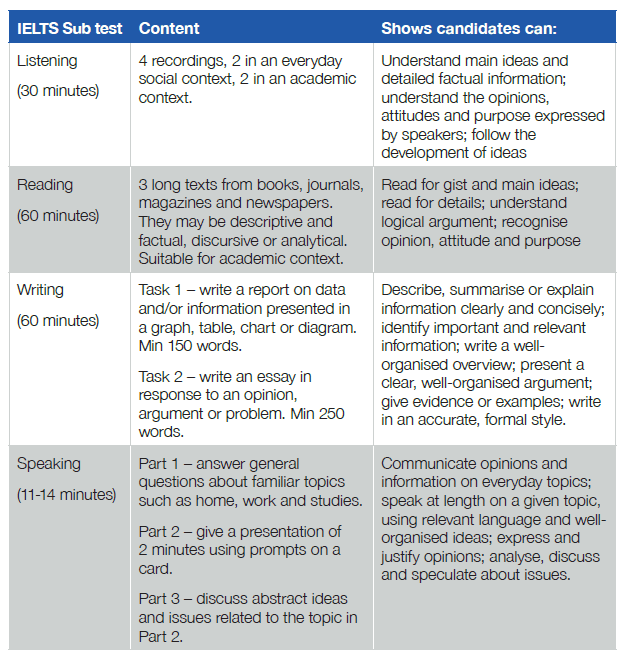
IELTS has the following format:

IELTS format

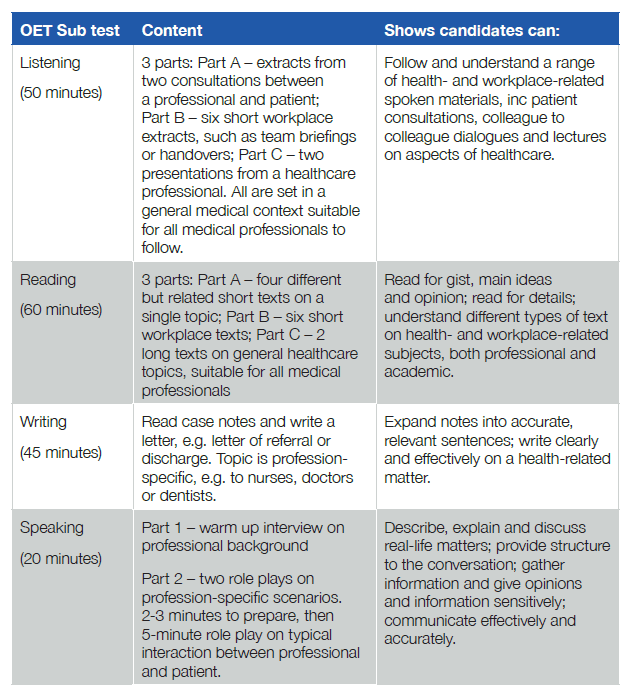
OET has the following format:

OET format

4. Preparation requirements

Preparing for IELTS involves learning huge amounts of vocabulary on a wide range of academic subjects so test takers are prepared to read academic texts quickly and effectively, understand lectures and discussions, talk about abstract questions and give opinions in detail. Test takers need to learn how to write reports on a variety of data and a range of essay types. Written texts need to be at an advanced level and so include complex structures and grammar. Learning a set of key exam techniques is also crucial.

Preparing for OET involves learning a wide range of healthcare-related and profession-specific language, so test takers are able to follow, engage with and participate in a variety of clinical scenarios, as well as understand medical texts and talks. They need to be able to write a healthcare-related letter, such as a referral letter, at an advanced level. They need to acquire a range of exam techniques so they can work quickly and effectively in the test.

As a result, preparation courses for the two tests follow very different pathways and use very different materials.

5. Scoring

 IELTS is marked out of 9, with a separate score for each paper. Half marks are awarded as part of this.

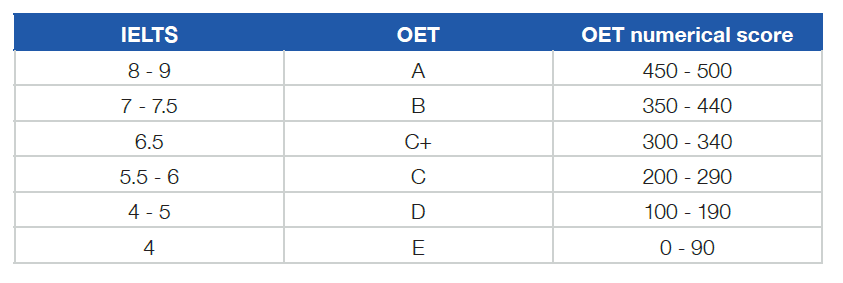
OET is graded from A (best) to E, with an equivalent numerical score to show more precisely where in the grade a candidate sits.

Healthcare regulatory bodies which use both exams to test English for healthcare professions tend to specify an advanced C1 level of language, i.e. around 7 in IELTS and a B in OET.  The score equivalencies between the two tests are as follows:

OET and IELTS scores

6. Recognition

 IELTS is recognised by universities, regulatory bodies, immigration authorities and companies in many countries around the world. This includes universities in non-English speaking countries where a course may be delivered in English. There are over 1,100 test centres in over 140 countries.

OET is recognised by healthcare regulatory bodies and Higher Education healthcare educators, including those in the UK, Ireland, Australia, New Zealand, Singapore, Dubai, Ukraine and Namibia. There are over 115 test centres in 40 countries.

7. Numbers of test takers

 Over 3 million people took IELTS in the past year, compared to the tens of thousands taking OET. This reflects the size and reach of the global Higher Education market on the one hand and the specialist nature of the OET on the other.

8. Preparation infrastructure

IELTS has a global infrastructure developed around preparing learners to take the test, including universities, specialist training organisations, private language schools, published materials, online content, and thousands of teachers and writers.

OET has a small but global preparation infrastructure, consisting of a growing number of specialist training providers and also a small but growing materials base. OET ’s Premium Preparation Provider scheme provides a framework for training organisations to undergo a rigorous accreditation process to demonstrate their ability to prepare candidates for the specialist nature of OET. SLC was the first provider to be accredited in Europe.

Pass your OET or IELTS with Confidence

We are Medical English, OET and IELTS preparation specialists. Our uniquely effective course design and delivery offers an unparalleled range of Medical- and exam-focused courses and tests.

Are you preparing for OET?

We offer a unique set of preparation services designed specifically for your success in the OET exam.

Are you preparing for IELTS?

Our courses will enable you to achieve a high score in the IELTS Academic English test.

More To Explore
Subscribe to our newsletter

Get updates and get the latest materials on Medical English, OET and IELTS

OET

What is the Occupational English Test (OET)

What is the Occupational English Test (OET)

The Occupational English Test (OET) is used in the UK, USA, Australia, Canada, Ireland, New Zealand and Singapore among others to assess the Medical English skills of a wide range of international healthcare professionals, including doctors, nurses, pharmacists, dentists, vets and allied health professionals.

OET Background

The OET was established in the late 1980s and developed under contract to the Australian Government. It was designed by Professor Tim McNamara at the University of Melbourne – one of the original developers of IELTS.

Since then, it has undergone continuous assessment and review, led by the Language Testing Research Centre (LTRC) at the University of Melbourne, in order to ensure it is fit for purpose today. LTRC is an international leader in research and development in language assessment.

The test is now owned by Cambridge Boxhill Language Assessment, a joint venture between Cambridge English Language Assessment (who co-own IELTS) and Box Hill Institute, a leading vocational and higher education provider.

OET Objectives

The OET is designed specifically to assess the English language skills of international healthcare professionals wanting to work in an English-speaking environment and reflects over 30 years of research and practice.

It consists of 4 papers: Listening and Reading cover a broad range of generally applicable healthcare topics, while Speaking and Writing test the specific language used by 12 professions within healthcare.

These are:

Dentistry, Dietetics, Medicine, Nursing, Occupational Therapy, Optometry, Pharmacy, Physiotherapy, Podiatry, Radiography, Speech Pathology, Veterinary Science.

OET Test Format

There are 4 skills-based papers: ListeningReadingWritingSpeaking.

The Listening and Reading papers are designed to assess a candidate’s ability to understand spoken and written English, based on health-related topics and tasks common to all professions. Texts range from short workplace notices and dialogues to longer articles and talks.

The Writing and Speaking papers are specific to the 12 individual healthcare professions. They are designed to reflect common tasks performed in the workplace. The writing asks candidates to write a referral letter, for example, while the Speaking asks candidates to role play a conversation in a clinical setting.

OET Scores

Most healthcare regulators who recognise OET, require candidates to score C+ or B in the 4 papers to achieve the standard of English deemed sufficient to provide safe and effective care.

In the UK, for example, the General Medical Council (GMC) requires doctors to score B in all 4 papers in 1 sitting, whereas the Nursing and Midwifery Council (NMC) requires nurses to score a B in Reading, Listening and Speaking and a C+ in Writing. The NMC also allows nurse to ‘club’ different tests taken over a 12-month period together to achieve the grades, as long as no paper is graded at under half a band below the requirement.

Enhance your English skills with Specialist Language Courses

Specialist Language Courses (SLC) are dedicated to helping healthcare professionals excel in OET. Our expert-led courses focus on the specific language skills and test strategies needed to succeed. With paper-by-paper study, live webinar lessons, practice OET tests, an OET grammar course and optional personalised coaching, we ensure you build the confidence and competence required for each OET sub-test. Join SLC to boost your chances of achieving the scores you need and advance your healthcare career.

OET Recognition

The OET is recognised by regulatory healthcare bodies and councils, as well as university and Higher Education institutions, in the US, UK, Canada, Ireland, Australia, New Zealand, Singapore, Malta, the Maldives, Philippines, Qatar, UAE, Spain, Ukraine and Namibia.

How do you take OET?

OET can be taken at test centres around the world, either on paper or on computer. OET also offers an at-home testing service, so candidates who do not have a test centre in their country can take it at home instead. Know more about the different ways of taking the OET exam here.

OET Free Preparation Materials

Get the latest tips and strategies from Specialist Language Courses by subscribing to our YouTube channel.

More To Explore
Subscribe to our newsletter

Get updates and get the latest materials on Medical English, OET and IELTS

Giving advice

Medical English Tips: Giving Advice Sensitively

Medical English Tips: Giving Advice Sensitively

Giving advice
Share This Post

Get this right, and your rapport with your patient will be a powerful factor in building a successful therapeutic partnership. Get this wrong, and your relationship may never recover.

Giving Advice Sensitively

There are some occasions, when healthcare professionals have to give advice in a sensitive manner. Think of some of the times, when you have had to do this. What sorts of things were you discussing?

Perhaps:

  • misuse of illegal drugs
  • misuse of legal drugs, e.g. using someone else’s medication, increasing the dose of your own medication
  • excessive alcohol consumption or lack of knowledge about safe levels of alcohol use
  • weight issues, e.g. obesity/overweight, underweight, eating disorders
  • body image issues, e.g. dysmorphia
  • depression or bereavement
  • avoiding STIs, e.g. use of safe sex

Now, think about the language you might use in these situations. It is useful to have a ‘scale’ of language in mind, when you are giving advice sensitively. In order to be effective, you will be using several communication skills. Here are 3 very useful skills:

a) Using non-judgemental language (both verbal and non-verbal)

At times, you may be talking about subjects which you find uncomfortable, so it is important to pay attention to your own body language. Are you using gestures (e.g. crossing your arms in front of your chest) or negative body positions (e.g. leaning back or away from the other person)? Are you using judgemental phrases, e.g.

You’re going to have to make more of an effort. You need to pull yourself together now?

b) Acknowledging the patient’s situation

In order to be non-judgemental, it is often a good idea to acknowledge the difficulty the patient may have with their particular health issue, e.g.

I can see you are finding losing weight very challenging.
It looks like you are having a difficult time coming to terms with your mother’s death.

c) Empathising with the patient

It is also a good idea to empathise with the patient, before giving any advice, e.g.

I imagine that it must seem almost impossible to tackle your drug issues.
I guess it must be overwhelming to deal with your weight problem.

Giving Advice

Now, onto the giving of advice in a sensitive manner. You may find you are using phrases such as:

It would be a good idea to..
It would be helpful, if you could…
It would be useful to think about…..
Would you be willing to try….?

As you can see, these phrases are similar to the phrases used to make suggestions. In contrast, when giving advice, you might say:

You should….(reduce your fat intake, exercise more etc)
You need to…(keep an eye on your weekly alcohol intake)

In the case of sensitive advice, these phrases may appear too harsh at first. Of course, in situations where immediate lifestyle changes need to be made, strong advice may need to be given, e.g. evidence of dangerous drug habits or unsafe exposure to infections. In these cases, you may use phrases such as :

You must…
It is essential that you…
It is vital that you….

Are you a student looking for Medical English courses?

SLC’s ground-breaking online Medical English courses gives you the language you need to work, study and collaborate in an English-speaking environment.

Just click on the course and start your Medical English preparation!

FREE Medical English materials for teachers

In Specialist Language Courses we offer free lesson plans to teachers so they can have the best materials to teach their students about Medical English.

You can subscribe to our newsletter where you will receive monthly email with the latest materials that SLC offers for free.

Medical English courses for teaching

We also offer the latest in online medical English resources and materials to transform your teaching programmes and accelerate your students’ learning.

Teachers and institutions use the courses in multiple ways – as digital coursebooks, as supplementary learning, and as part of a flipped classroom approach. We can advise you how to integrate the materials to meet your objectives.

Interested in using our courses? Click here:


Subscribe to our newsletter

Get updates and get the latest materials on Medical English, OET and IELTS

More to explore
GMC Doctors

GMC English Language Requirements for European Doctors

GMC English Language Requirements for European Doctors

GMC Doctors

Share This Post

The GMC uses the following evidence to demonstrate that a European doctor qualifying from one of the member states of the European Economic Area (with the exception of the UK) has sufficient English language skills to practice safely and effectively in the UK.

Evidence Type 1: Academic IELTS 7.5

Doctors should have an overall score of 7.5 in the academic version of the International English Language Testing System (IELTS) from the last 2 years. As part of this, a doctor must score a minimum of 7.0 in each of the four papers: reading, writing, listening and speaking. These scores must be achieved in one sitting of the test.

This, in practice, is how most overseas doctors demonstrate their knowledge of English. The GMC may accept IELTS test scores that are more than 2 years old if a doctor can show that their English language skills have not deteriorated in that time. They may have worked in a country where English is the first language for example, or they may have taken a postgraduate course of study which has been taught and examined in English.

While IELTS is currently the only test recognised by the GMC, the organisation is open to alternatives in the future which can be shown to be reliable and appropriate tests of a doctor’s English language skills.

Evidence Type 2: A primary medical qualification (PMQ) that has been taught and examined in English.

The GMC requires the PMQ to have been taught and examined in English and to be from the last 2 years. As part of this, at least 75% of the doctor’s clinical interaction, including personal contact with patients, relatives and other healthcare professionals, must have been conducted in English

Where the PMQ is not so recent, then the GMC requires clear evidence that the doctor has extensive experience practising in English over the previous 2 years in a country where English is the first language, to include employer references.

Practice may be clinical, teaching, management or research-based. The GMC will take into account whether this is continuous or periodic, and ensure that the practice uses the knowledge, skills, attitudes and competences gained in a medicine degree and any further study.

Evidence Type 3: an alternative language test for registration with a medical regulatory authority in a country where the first and native language is English

The GMC will explore which test was used and what requirements were met. If the test pass is over 2 years old, then the GMC may ask for evidence that demonstrates the doctor’s experience of practising for the preceding two years, as outlined above in evidence type 2.

Evidence Type 4: An offer of employment from a UK healthcare organisation

The GMC requires written confirmation from the UK healthcare organisation that an offer of employment has been made, and that the healthcare organisation must be a designated body. The GMC may also ask for evidence of a doctor’s English language skills along the lines outlined above in Evidence Types 1, 2 and 3.

As part of this process, the GMC requires the appointing clinician to complete an English language reference form detailing the applicant’s skills in reading, writing, listening and speaking, and how these were assessed during the recruitment process. The appointing clinician must then get confirmation from the Responsible Officer for the employing organisation that they endorse the recruitment processes the employer has in place to ensure that the applicant has the necessary knowledge of English to practise safely in the UK.

Evidence Types, 2,3 and 4 do not apply where a doctor has taken the IELTS test and failed to achieve the scores stated in Evidence Type 1.

For further information

For further study

Subscribe to our newsletter

Get your monthly updates and latest materials on Medical English

More to explore